Saturday, August 3, 2019

The launch before the storms...

Rocketeers awaiting their chance to fly at Saturday's launch (Click to enlarge).
During the HARA club meeting Thursday night, Allen announced that he and a few others would gather at Pegasus Field East today for some rocket flying - at 8:30 AM! My initial reaction was "ain't no way I'm getting up early on a Saturday", but by dinner time on Friday I had changed my mind. The lure of flying a few rockets was just too strong, and besides, the day would be cooler in the morning. So I linked up with Duane just before 8:30 and we trundled off down the road. Only Martin was there when we arrived at the field, but the three of us were enough to get the canopy, table, chairs and pads set up. Allen showed up next, followed by Collin and his daughter and Josh and his dad, Dean. A few other folks who were going to fly some Estes birds of their own also arrived on the field, and we were able to assimilate them into our launch with ease. Rounding out the party was Julian and his family, along with Blake - a bit bigger crowd than normal, but that only added to the day's fun.

Collin and his daughter prep their rockets (Click to enlarge).
Flying got started around 8:45 with the launch of  my MPC Icarus clone. Powered by an A8-3, it had the questionable Micropeak altimeter tucked into its payload bay, as I was determined to see whether that device was truly wonky or if the exposure to direct sunlight on the previous two flights was the culprit behind the funky readings. The Icarus performed flawlessly, deploying the parachute near apogee and making a soft landing in the grass; I am also happy to report that the Micropeak worked exactly as it should, reporting a peak altitude of 221 feet. It seems to work fine if the device is fully enclosed.

My Icarus starts the launch (Click to enlarge).
Altimeter data from the Icarus Micropeak (Click to enlarge).
The rockets flew fast and furious for about 3 hours - so fast that I could not keep up, failing to record a few of the launches due to too many things going on at the same time. I only know the motors used in a few flights besides my own, so I'm going to hit the highlights of the day (in my opinion, of course) in this post.

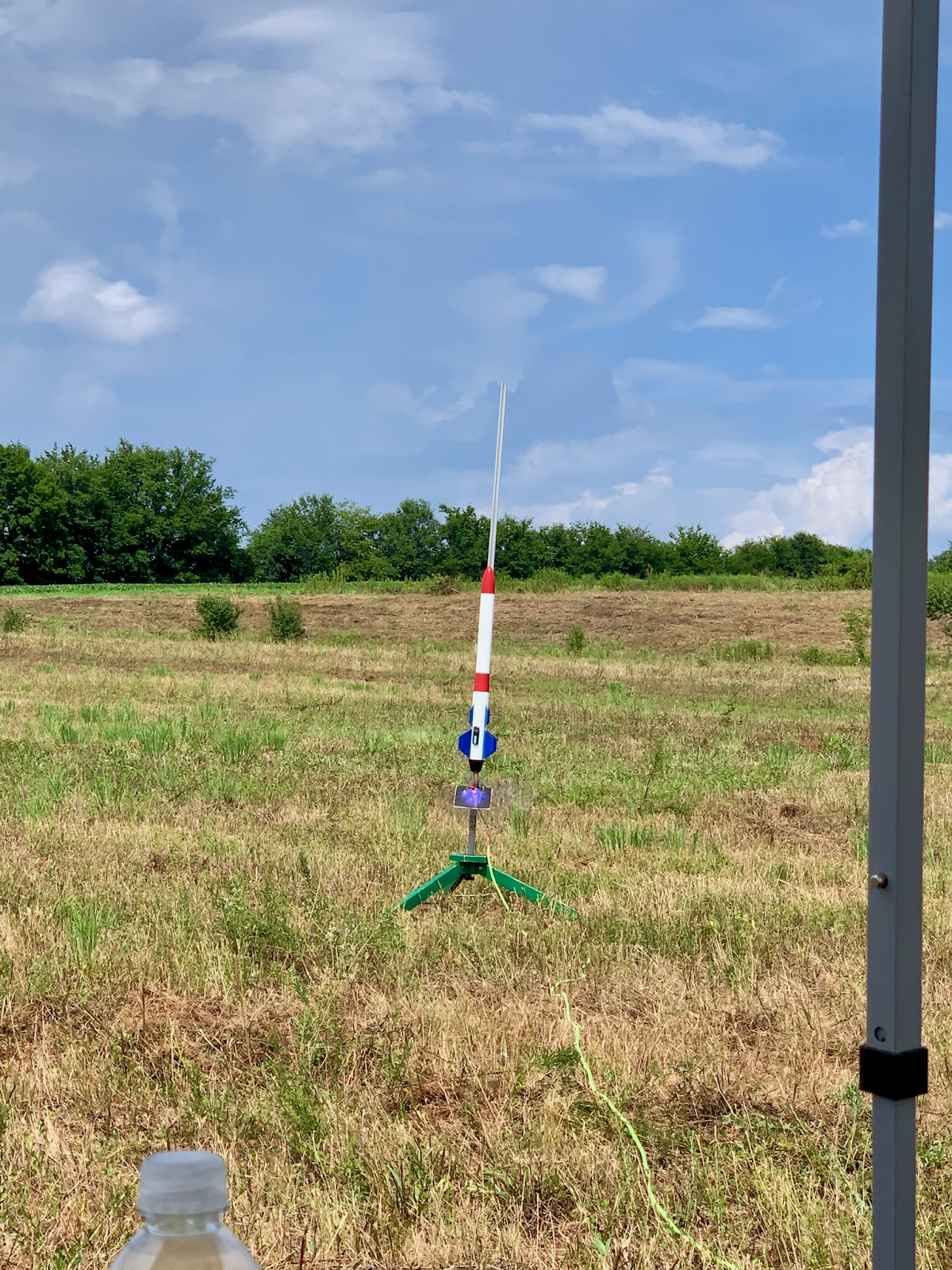
The A8-3 in my Zeta ignites (Click to enlarge).The Photon Probe gets going (Click to enlarge).
In addition to the Icarus, I sent my newly built Zeta on a picture-perfect flight with an A8-3. It was followed by my Estes Double Ringer; the C6-3 got it up to a decent altitude, where it deployed the cylindrical gliders. Unlike Allen's - who flew his Double Ringer on a D16-4 - my gliders actually glided, with one making a shallow swoop to the very edge of the field. Unfortunately, I botched turning on the keychain camera strapped to the side, so no video - I was really hoping to get a few frames of glider separation. Switching next to something a bit simpler, I loaded my clone of the Centuri Stellar Photon Probe on the pad, and it also performed well on a B6-4. The rocket landed not far from the canopy, coming down slowly under an 18" plastic Estes parachute.

Ignition of the Double Ringer's C6-3 (Click to enlarge).The Double Ringer's gliders way up there
(Click to enlarge).
Inspired by Duane's multiple altimeter checkout by putting all of them in the same rocket, I did the same with my last flight of the day by placing a Perfectflite Firefly and one of my Micropeak altimeters in the payload section of my Probe-18 rocket. The B6-4 pushed the model to just over 380 feet, and I was very gratified to see the agreement between the two altimeters.

The Probe-18 adds more scorching to my blast deflector
(Click to enlarge).
Probe-18 under parachute (Click to enlarge).
Comparison of the Probe-18 altimeters (Click to enlarge).
So much for my stuff - now on to the highlights. Josh's Estes Airshow was the first of these, with both gliders putting on a nice show.  Duane's School Rocket flew well on an Aerotech E15 and Allen launched his finless ducted rocket on a partly stable flight that started out well but ended up in some serious corkscrewing around the sky. Inspection of the recovered model showed why - a sizable fraction of the lower tube had burned away! One of Josh's rockets, "Please don't melt" also suffered a heat mishap - being entirely 3D printed, some of the lower section melted badly, despite the name.

Josh's Airshow clears the rod (Click to enlarge).Airshow glider doing its thing (Click to enlarge).
Coming in for landing (Click to enlarge)!Duane's School Rocket leaves the pad
(Click to enlarge).
Liftoff of Allen's ducted rocket (Clicked to enlarge).Aftermath of the flight (Click to enlarge).
"Please don't melt" soars into the sky (Click to enlarge).Josh holds the melted pieces (Click to enlarge).
Duane had loaded three altimeters into one of his Geezer TARC rockets, and they all agreed that the F32 propelled the model up to around 645 feet, give or take a few. This was good news, as a couple of these altimeters were ones the John Paul II TARC teams had labelled as bad. This flight seemed to indicate that the bad readings were from user handling rather than equipment malfunction. Allen then launched the most impressive flight of the day - his BMS School Rocket was loaded with a G127 Redline, and it put that puppy up to 2226 feet in a flash! Top speed was 434 mph and the electronics took 28 g's during the flight. Something tells me Bill Saidon at BMS never designed the rocket for such a beastly motor, but we are very glad Allen got the model back in one piece. It was by far the coolest flight of the day.

Duane's rocket lifts off with its cargo of altimeters
(Click to enlarge).
Allen's School Rocket under G127 power
(Click to enlarge)!
There were many other flights, mainly by Estes kits. Amazons, Crossfires, Lynxes, Cobras, and Nike-X's all took to the air multiple times, and I think Josh must have flown pretty much his entire fleet. We departed the field at noon, and Duane and I hit the local Arby's for some needed sustenance. I had just arrived back at the apartment when a series of thunderstorms broke loose, and I felt pleased that we had chosen to launch in the morning. Sometimes things work out in good ways - today was one of those times.

A Nike-X under power (Click to enlarge).An Estes Amazon streaks towards the clouds
(Click to enlarge).

Wednesday, July 24, 2019

A fun launch!

1 PM Sunday saw me and Duane setting up his canopy at Pegasus East. The day was humid, with intermittent light showers intermixed with a very hot sun, and I sure was not going to sit in my camp chair without something over my head; besides, we needed cover to insure that the rockets and motors didn't get wet. It was our first real launch in months, and nothing was going to stop us from flying a few rockets. Duane had prepped 7 models, I had 4 ready to go, and Vince showed up with 3 of his own - the next couple of hours were going to be filled with rockets taking to the sky and the small clouds of black powder smoke wafting downwind. We also had a couple of spectators - Allen and his friend Laura stopped by the field to watch a few launches. Allen committed a minor sacrilege by bringing a non-flying Lego Saturn to the field, but it was easily forgiven in our zeal to ignite some motors.

A trifecta of Saturn V's launched on Sunday. From left, Duane's (C6-3), Mine (C12-4), Vince's (C6-3)
(Click to enlarge).
First to launch was Duane's 1/200th scale Estes Saturn V on a C6-3. It was a textbook flight, with the parachute deploying at apogee and a gentle landing on the grass. Mine and Vince's Saturns would also make great flights later on, and I must confess I am rather fond of this Estes RTF, which looks great on display and in the air. I highly recommend purchasing one for your fleet.

The America lifts off on a B6-4 (Click to enlarge).Duane's "Beast" finally gets going on an old Redline
motor (Click to enlarge).
This year's 4th of July rocket, the #1447 Estes America, followed Duane's Saturn V. The A8-3 powered it to just over a couple of hundred feet, where it deployed its 9" nylon parachute for a safe, soft recovery.

Duane loaded his venerable old Geezer TARC "Beast" on the rail we had set up to the east of my tripod pad. This rugged yellow and black rocket was propelled by a much older Aerotech F27-8R Redline manufactured in 2007! As you might expect, this motor huffed and chuffed for several seconds before finally sending the Beast skyward on a nice pillar of red flame. After the chute deployed, Duane remarked that it probably was the best flight he'd seen with this model; I kept my thoughts about being too cheap to get fresh motors to myself. Seriously, Duane inherited a store of old motors and he seems determined to fly them, even if there might be a CATO or two (Most of them just chuff like crazy). I have to admire his guts.

The Beast descending under parachute
(Click to enlarge).
The Rookie's first stage motor ignites
(Click to enlarge).
My Estes ARTF (Almost Ready To Fly) Rookie was next. I had mated it to an Estes booster designed for this class of models, so it flew two stage on a C11-0/B6-4 combination. My HD keychain camera was taped to the side and there was a Altus Metrum Micropeak altimeter tucked inside, so this puppy was instrumented to the max. The flight was good, but Murphy whacked me hard - the Sun was obscured by clouds at launch, making for a very dark video (keychain cams have poor sensitivity), and the altimeter readings were pure nonsense. I think this was the same altimeter that gave bad readings on the SLS test flight several days ago; back then I thought it was because there were no vent holes in the SLS model, but the Rookie had them, so I'm thinking I have a defective altimeter. I will have to contact Altus Metrum and see what can be done about a repair or replacement. Anyway, I did get a nice staging sequence from the camera, so the flight was not a total failure.

Staging sequence from the Rookie onboard camera (Click to enlarge).
Back on the rail pad, Duane had his Estes Trajector ready to go. He must have felt the need for some altitude, for the Aerotech F42-8T put that bird way up there in the highest flight of the day. Allen remarked that it would have probably been wise to have used a Jolly Logic Chute Release, a sentiment I'm sure Duane shared as the Trajector was borne by the wind far away to the northeast, past the tree line and into a soybean field. He was gone quite a while on his search, but came back with the rocket and a few pounds lighter from his trek in the hot Sun.

Duane's Trajector leaves the rail (Click to enlarge).The last glimpse of Vince's world record attempt rocket
(Click to enlarge).
Vince's first flight was also the only one that resulted in a lost rocket. He had volunteered at the Space and Rocket Center world record attempt, and so acquired a few of the models. This "Guinness Pathfinder" was loaded with an Estes C6, and we never saw it after he pressed the launch button. Our best figuring placed it down near the south edge of the field, but who knows? Vince did take a quick tour of that side, but turned up nothing. I have made a note never to fly my model on a C; heck, I'm not going to use more than A impulse - if I fly it.

Duane readies his Death Star as Allen leaves the area (Click to enlarge).
Duane then flew his Estes Death Star in what was perhaps the most fun flight of the afternoon. The C6-3 took the rocket up to a peak altitude of about 150 feet, whereupon the Death Star broke apart into 4 pieces, each recovered by a bright orange streamer. Allen and Laura were delighted by this model, and Duane certainly enjoys the comments made each time he flies it. I followed the Death Star with a launch of my scratch Probe-18 rocket, loaded with another Micropeak altimeter. The flight was textbook and the altimeter returned good data. So at least one of my Micropeaks work.

The Death Star heads up the rod (Click to enlarge).My Probe-18 gets going on a B6-4 (Click to enlarge).

Data from the Probe-18 Micropeak altimeter (Click to enlarge).
Vince launched a nicely-built Semroc Recruiter on an Estes A8 - I think he was done with C motors in light rockets for the day. It deployed the parachute near apogee and landed close to the pads, making for a short recovery jaunt. Duane went next with an Odd'l Rockets Birdie, which did what Birdies do - leave the pad fast, turn over, and plop down on the ground. A nice quick flight on an Estes A10.

Vince launches his Recruiter (Click to enlarge).The blast deflector glows purple under the motor
exhaust of Duane's Geezer TARC rocket
(Click to enlarge).
The last two flights of the day were made by Duane - his red, white, and blue Geezer TARC rocket soared to 501 feet on an F39 composite, and the Chute Release deployed the parachute pretty close to 300 feet (one again wonders why it wasn't in the Trajector?). The very last flight was made by his Cherokee-D, which got decent air on a B6-4. There was a comment or two about a "Cherokee-B", but I couldn't throw shade - a D motor in that bird on that field would have been tantamount to rocket suicide.

Last flight of the day - Duane's Cherokee-D on a B6-4
(Click to enlarge).
Duane recovers a Saturn V (Click to enlarge).
And that, good readers, was the first part of my Sunday afternoon. I must say, it felt great to be flying again!

Saturday, July 20, 2019

More about Tuesday...

A friend of mine presented me with one of the rockets used in the 5000 rocket world record attempt on Tuesday - it's the Space Camp rocket, Pathfinder, with special stickers to commemorate the occasion and the sponsors. Pathfinder is BT-20 based, with a red plastic fin can and blue nose cone; this variant not only has the special stickers but the parachute has been replaced by a too-small, 6" long mylar streamer for recovery. It's so short as to be useless - they might as well have just gone with simple nose blow recovery. Anyway, this model has joined my collection, and I thought I'd share some close up pics of it.

A rocket used in the 5000 rocket
Guinness attempt (Click to enlarge).
Close up showing the Guinness decal (Click to enlarge).
Launch lug side of the rocket (Click to enlarge).
In the first image you will notice a coffee stirrer attached to the rocket. This prevented the rocket from twisting around and causing the nozzle to come off the electric match. Without this, there is a non-zero chance the motor would not ignite. Even with it, about 80 rockets (1.6%) failed to leave the pad. The image below shows the rear of one of those - note the scorch mark on the motor, showing the match ignited outside the nozzle.

Hind end of one of the rockets that did not leave the pad showing
the scorching left behind by the electric match (Photo by
Allen Owens - Click to enlarge).
Chuck captured and posted a video of the Saturn V and SLS flights at MSFC. You may hear some colorful language just after the Saturn launch; something stung Chuck on the wrist, and judging from the mark and swelling, it had to have hurt. Unlike me, Chuck doesn't get rattled by such things and he was pretty much back to normal after a few minutes and the application of some sting relief. I would have generated much more drama.


We have scheduled a launch for Sunday, so hopefully I'll get some more flying done then. Stay tuned!
Tuesday, July 16, 2019

The celebration begins...

Today marked the 50th anniversary of the launch of Apollo 11, the mission that landed the first men on the Moon. Huntsville and Marshall Space Flight Center played a very prominent role in Apollo, as the Saturn V rocket was designed and tested here. So you can imagine that today and the next few days feature many local events to mark the occasion, the first being a new world record attempt at launching the most rockets simultaneously. Stuck at work, I was glued to my computer this morning at 8:32 AM Central Daylight Time, watching the live stream of 5000 rockets powered by Estes 1/2A6-2 motors take to the air. It was most impressive, and the initial numbers indicate that somewhere around 4920 rockets successfully left the pad, with about 44 of these not making it to 100 feet (a requirement of the record attempt). If these numbers hold, then a few weeks from now this launch will be the new record holder, surpassing the previous biggest mass launch by over 600 rockets. Kinda cool.

In case you missed it, here's one of the YouTube videos of the launch:


Loading the rockets on the racks (Photo by Allen Owens - click to enlarge).
After the launch - A pile of rockets!
(Photo by Allen Owens - click to enlarge).
The next event was something in which I was an active participant - the launch of the Estes Saturn V and SLS models kicking off the MSFC celebration. Chuck Pierce and I arrived at the center softball field around 2 PM, and set up a HARA low power rack and hooked up the the controller. 45 minutes later, we launched the Saturn V after a countdown done by a lot of kids from the daycare center. Just like in last week's test flight, the Q-Jet C11-4 powered the model to a respectable altitude, and it deployed the parachute soon after apogee. The breeze - about 10 mph from the SSW - carried it out of the field over into a nearby parking lot, where it was recovered by a fireman (on standby if the launch should start a fire). No damage, so I was happy. Flight #2 on my Saturn V complete.

My Estes Saturn V kicks off the MSFC Apollo 11 celebration (Click to enlarge).
The SLS was launched next. As you can see from the image, the Estes C6-3 motor seemed to produce a lot of flame on lift off, enough to burn through half of one of the black fins. I'm pretty sure some of this was caused by the model being too close to the flat metal blast deflector, which probably directed the exhaust onto the fin. However, the motor still looked a little "hot" to me - still scratching my head a bit over this one. The SLS put in a good flight, deploying its parachute right at apogee and landing just on the edge of the softball field. But the post flight inspection of the rocket showed not only the damaged fin but also no nose cone; it had separated from the clear plastic base either at ejection or upon hitting the ground. A quick search of the area turned up nothing, so I suppose you could say that the launch was successful, but we lost the crew on landing.

The SLS heads up the rod - look at the motor exhaust from the C6-3! (Click to enlarge)
After the MSFC launch, Chuck dropped me off at the newly mowed field across the street from our old launch area (I think I will call it "Pegasus East"). Here Vince and some of the Hope Rising rocket kids were flying models as part of the Space and Rocket Center's Global Rocket Launch. Vince launched his 1/200th scale Saturn twice, both times on C6-3's, and the Hope Rising students put up BMS school rockets on A motors, with everything recorded by the cameras of a visiting Japanese documentary crew. All flights were good, with nary a CATO or failed recovery. Being old, fat, and very hot, I sat in a camp chair and provided commentary - something I am very skilled at.

Vince in full NAR regalia; behind him, a student and Constance begin to load a
rocket on his very robust pad, built on a telescope tripod (Click to enlarge).
A School Rocket takes to the sky (Click to enlarge).The documentary crew at work (Photo by
ChrisAnn Driskill - Click to enlarge)
Saturn V flown, Apollo 11 launch commemorated - Good way to start off marking the 50th anniversary of the first steps on the Moon.

Thursday, July 11, 2019

Test flights...

Monday was test flight day, so 4 PM found me - along with Allen, Duane and a few friends from MSFC - at the field across the street from our old launch site. It was very, very hot - the area was under a heat advisory, with feels like temps over 102 degrees - so I did not dawdle setting up the pad and controller. I had already prepped the rockets (sans igniters) the night before, so I expected things to go quickly - which would be good, as I wanted to get back into a place with some air conditioning.

Estes 1/200th scale Saturn V on a C12-4 (Click to enlarge).
First up was the Estes Saturn V, flying on a Quest QJet C12-4. I had a little trouble getting the igniter to stay in place - I'm still new to using these composite motors, and after trying various sizes of Estes igniter plugs, I finally settled on using good old masking tape, which worked fabulously. The Saturn rode a trail of thick black smoke up to 394 feet; I held my breath, waiting for the parachute deployment, which occurred well past apogee. Fortunately, the shock cord held, and even better, the Saturn missed hanging up in a tree near the road. A successful flight!

I had equipped all of the rockets with small altimeters, knowing full well I could get crap readings given the lack of vent holes in the models. But I figured nothing ventured, nothing gained, and the very small additional weight would not impact flight performance. So the Saturn and SLS rockets had Altus Metrum Micropeak altimeters and the Saturn 1B contained a Perfectflight Firefly. The Saturn V altimeter was the only one that returned usable data; the SLS Micropeak readings were a bunch of crap, and dumb me forgot to turn on the Firefly in the 1B (still kicking myself over this, but hey, I wanted to get out of the heat).

Saturn V Micropeak altimeter readings(Click to enlarge).
Next up was the SLS, loaded with an Estes C6-3. We adjusted the rod angle a bit to avoid the trees near the road and gave the count. The SLS rose into the blue sky, reaching a respectable altitude and deploying its parachute just past apogee - a very nice flight! I must express my thanks to Allen, who braved bugs and who-knows-what-else recovering the rocket from the knee-high weeds.

The Estes-built 1/200th scale SLS lifts off on a C6-3
(Click to enlarge).
Last to fly was my grizzled old Cox Saturn 1B. It blasted off on an Aerotech D10-3, which chuffed a bit before propelling the rocket skyward on a streak of white fire (I love the White Lightning motors!). The 1B achieved the highest altitude of the day, but the ejection charge rammed the parachute up into the hollow capsule/LEM adapter, which kept it from opening. I watched in horror as the model fell to the ground, hitting near the edge of the weeds with a thump. Fortunately, there was very little damage - the escape tower had broken off and was missing, but the rest of the model was intact. She will fly again, as soon as I can figure out how to make or get a new escape tower.

My Saturn 1B on an Aerotech D10-3 (Click to enlarge).
Test flights complete - we are now ready to launch the Saturn V and the SLS at MSFC's Apollo 50th celebration on July 16.


Saturday, July 6, 2019

Rocket science...

My place of work, Marshall Space Flight Center, is hosting a series of employee events to mark the Apollo 11 50th anniversary on July 16. One of these will be a launch involving the Estes 1/200th scale Saturn V and a custom SLS (also built by Estes) of the same scale. My job is to work with Chuck and the Public Affairs people to get everything tested and ready so that our center director can press the fire button. I'm rather enjoying it, especially given that the test flights are coming up early next week. Have to make sure we have the right motors and the birds fly straight - Redstone Arsenal insists we keep the peak altitudes low, and an unstable flight would pose a risk to the onlookers. So we test.

Estes custom SLS and Saturn V rtf - 1/200th scale (Click to enlarge).
But a few calculations are needed before the test.

As mentioned in a previous post, the only recommended motor for the Estes Saturn V is the C6-3. However, the liftoff weight of the model is 172 grams (6.1 ounces), well above the maximum recommended weight of 113 grams (4 ounces). This is not a good situation, and the Internet has many accounts of the model achieving a very low altitude and ejecting the parachute well past apogee. But there are other 18mm C and D motors available - do they provide a more acceptable performance?

Reproducing the rocket in Rocksim or OpenRocket would have taken a lot of time, so I resorted to using an app I have on my iPhone (RocketCalc) with inputs from my measurements (weight, maximum diameter) and Thrustcurve.org (which also has an app). I also used an online descent rate calculator to check the descent rates to make sure they were slow enough to avoid damaging the model. The results for the Saturn V are below - note that the C6-3 gives a thrust-to-weight that is way too low (should be around 5) and that the burnout velocity is under 100 feet per second. Maximum altitude is only 200 feet. Easy to see why this motor produces flights that are nail-biters. The next motor, the Quest C12-4, produces a decent thrust-to-weight, burnout speed, and altitude, but the delay is about 1.8 seconds too long (4 versus 2.2 seconds to apogee). This means the parachute will deploy after the rocket has fallen 52 feet from its peak, where its speed is a fast 58 feet per second - quite a stress on the shock cord and attach points! The best motor choice is the Aerotech D10-3W, but the projected 651 foot altitude blows right through the ceiling imposed by the Arsenal, so it's out. The Quest D16-4 also has some good numbers, but the delay is too long, by the same amount as for the C12. The irony here is that the C6-3 is the best choice as far as delay, but the other numbers suck bad. Also, the reports out there in the wild mostly state that ejection was well past apogee, which flies in the face of these calculations.

Performance calculations for the Estes 1/200th scale Saturn V (Click to enlarge).
Which is why we are going to test - with a C12-4. I'm hoping she stays together.

I repeated the calculations for the Estes-built SLS, first calculating an effective diameter from the sum of the frontal areas of a BT-60 and 2 BT-20s (49 mm). It's lighter than the Saturn, and here the C6-3 is the right choice. The thrust-to-weight is a little low, but the altitude is comparable to that of the Saturn on a C12 and the delay is good.

Performance calculations for the Estes custom 1/200th scale SLS (Click to enlarge).
And while I was at it, I ran the numbers for my repaired Cox Saturn 1B, which is the pig of the three. Even though it won't fly at the MSFC event, I will probably launch it during the testing of the other two models. Since I won't be restricted in altitude, the D10-3W is the obvious choice here.

Performance calculations for the Cox 1/125th scale Saturn 1B (Click to enlarge).
Motor choices made - here's hoping for good testing weather!