Sunday, December 4, 2016

Easy interchangeable motor mounts...

Folks sometimes ask me why I like clusters so much - while it is true that I like duplicating reality (practically all launch vehicles of size make use of clustered engines), it is also true that the variety of black powder (Estes/Quest) motors has decreased with time. No longer do we have the "port-burning" B8, B14, or C5 motors, capable of propelling heavier models off the launch rod or serving as the 1st stage booster in 18 mm 3 stage rockets, such as the old Estes Farside or Centuri Arrow 300. This is why the Estes Comanche-3 uses the 24 mm C11 in the 1st stage - no 18 mm motor in the current line up can safely lift the model. So when I need heavy lift, I often resort to 18 mm clusters (yeah, I know - there's the Aerotech D21, but a) it's a composite and b) is fairly expensive). Besides, clustering adds a bit more suspense to the launch and the rocket definitely looks cooler riding multiple pillars of fire into the sky.

My RX-16 blasts skyward on 2 C6-5 motors (Click to enlarge).
So you can easily see why I was intrigued when Centuri released their "Rocketry Exploration Power System Outfit" back in 1977. Designed to teach "advanced" rocketry, it featured a 18mm 2 stage minimum diameter payload model (the RX-7) and, wonder of wonders, a ST-16 (BT-60) based payloader (the RX-16) with interchangeable single and dual 18 mm motor mounts. The motor mount setup, called "Plug and go" was simplicity itself - A JT-60 coupler was glued into the main body tube at a depth corresponding to the length of a JT-60 coupler. Then the end of a motor hook was inserted into a slit cut just below the coupler; this was held in place by gluing a piece of paper-like material (Tyvek) to the body tube over most of the length of the hook. The motor mounts were constructed the standard way using JT-60 couplers. All you had to do was pull back the hook, slide the motor mount into the tube, and release the hook, which prevented the mount from separating at ejection - just like inserting a motor. My youthful self was all over this - I ordered one of these sets, which unfortunately did not last a year (I was pretty hard on rockets back then).


Pages from the Centuri Power System manual showing the construction of the RX-16
Click here for the full size scans.

Flash forward to summer of 2011 - While looking for a new project, I ran across the Power System manual on Ninfinger's site. I remembered how much I enjoyed the versatility of the RX-16, and after confirming that Semroc had all the parts (Balsa version of the plastic cone and laser cut fins being the most important), set about building a clone. However, this time I would add a 3rd motor mount - for 24 mm motors - in addition to the two that were part of the set. Because of its versatility, the RX-16 soon became the workhorse of my fleet, lofting cameras and altimeters to a range of altitudes and testing stuff like the Jolly Logic Chute Release. I love this rocket - I can choose a low impulse B for small fields, cluster A motors for school demos, or cram a D into it for altitude or payload lofting. It is incredibly flexible.

The "easy peasy" motor mount retention system
(Click to enlarge).
The motor mounts (Click to enlarge).
So flexible in fact, that I decided to include the "Plug and go" concept into Beulah, a Big Bertha derivative with a payload section. Good thing I did, for Beulah is built for survivability and turned out to be a bit on the heavy side - I have to resort to C's or D's to get decent altitude out of her, even with an empty payload section. 

Beulah - Bertha and Betty's big sister (Click to enlarge).
There are other schemes for interchanging motor mounts, like the twist and lock approach used in the the Semroc SLS kits and the MRC Concept Series. The Centuri approach has the advantage of simplicity and is very easy to implement - even for novice rocketeers. Give it a try if you want a versatile mod roc.

Saturday, November 26, 2016

The 2016/2017 build list...


I admit to suffering from rocket ADD - it is far too easy to distract me from existing or planned projects. One look at a Facebook image of a rocket, an old catalog page, or a thread on Ye Olde Rocket Forum is enough to start an impromptu build, pushing the existing construction to the bottom of the queue. Given this, one may wonder why I bother to compose a list for the winter build season. The answer is simple - I generally manage to construct over half the models on the list, which, IMO, is pretty good. Let's consider the 2014/2015 build plan:
  • Big Bertha - No brainer. No fleet is complete without a Bertha, and mine was put out of commission at the Rocket City Blast Off.
  • Beulah - A Big Bertha derivative, featuring a two motor cluster. Inspired by Chris Michielssen's Big Girtha.
  • Centuri Micro-Probe clone - One of the best looking 2 stage rockets ever designed.
  • S.S. Cestris by Sirius Rocketry - Been wanting to build this kit for some time.
  • Estes Gyroc clone - Always wanted to build one of these "Helicopter recovery" rockets. A classic.
  • SpaceX Falcon 9
  • Estes Scrambler clone - The quintessential egg lofter. never had one of these as a youngster, though I really, really wanted one.
  • Estes Orbital Transport - Yes, it will be a pain to build. But it looks and flies so cool... love the glider!
  • Tiny Tim scale model - Have the parts, have the design, time to get this puppy built
Of these, I built the Big Bertha, Beulah, the Centuri Micro-Probe clone, the SpaceX Falcon 9, and the Estes Scrambler clone. That's 5 out of 9, or about 55% - certainly enough to warrant making a list for this year. However, I must account for my rocket ADD, so I'm going to keep it small to allow for the "impromptu projects." Therefore, the 2016/2017 plan is comprised of only 3 rockets:
  • Estes Gyroc clone - A carry-over from the 2014/2015 list. Important to build this one as 2017 marks the 50th anniversary of the kit's release.
  • Centuri Mach 10 clone - Had one of these as a kid, but I could never get a decent glide out of it. Time to try again.
These three will do for a start. I would also like to get around to the Orbital Transport and the Semroc reproduction of the Estes Trident sometime in 2017, but you never know - there are lots of distractions in the rocket universe!

Sunday, November 20, 2016

Recovering from burn out...

This is a short catch-up post - have been fighting a cold for just over a week and am not my usual verbose self.

October was filled with scouts and rocketry - we had scout launch events on 3 Saturdays, which kept me and other HARA members quite busy. Busy enough that I began to feel like my hobby was becoming work. And when the fun stuff is no longer much fun, burn out happens. Adding in a couple of out of town trips over Halloween and the 1st week of November resulted in a perfect equation for not getting much rocket building done. Progress on the Mars Snooper stopped, there was one awaiting finishing on the bench, and I had another two in primer, screaming at me for coats of paint. I just couldn't summon the enthusiasm to move these projects along.

Fortunately, some motivation returned this past week, probably because Pegasus Field has now been mowed, clearing the way for weekend launches. I managed to get my Mini Max out of primer into paint and made some decent headway in building the Mars Snooper. Still not done with the construction - there are lots of pieces, and I am sealing the balsa as I build (can you believe 7 nose cones, plus a transition and fins?), but I can see the light at the end of the tunnel. I also added the final coat of primer to my Enerjet 2250 down scale. Too much sanding, but things are now moving along.

We also held an inaugural launch for this seasons flying at Pegasus - Duane, Allen (a new HARA member), and I managed to put a few rockets into the air last weekend, and I can tell you that it felt good to actually fly some of my rockets! The four chosen were my Ghost Max (Estes Red Max with Ghostbusters markings from Stickershock 23), my Orange Max (a dual engine Red Max with Halloween decor), the Squirrel Works Vulture, and my Estes Bandit clone.  All the flights were flawless, and my birds came away unscathed; it was a good day to fly!

My Ghost Max looking pretty on the pad (Click to enlarge).
Dual A8-3's power the Orange Max up into the blue sky (Click to enlarge).
Duane's Squirrel Works "Pumpkin Pie" is ready to go (Click to enlarge).
Allen's Patriot emerges from the smoke (Click to enlarge).

Wednesday, September 28, 2016

TARC workshops and cell towers...

In terms of rocket events, September has been a busy month. A few days after the Geezer TARC launch, HARA hosted a Saturday TARC workshop at the Educator Resource Center located on the grounds of the Space and Rocket Center. The idea was to condense the information offered in HARA's hour long classes - which took place just before the monthly club meetings during TARC season -  into one day; we figured this would better enable the teams to get a good quick start into the competition. It worked out pretty nicely, and we got some nice compliments and feedback that will make next year's workshop even better.

TARC teams building the BMS School rocket at the HARA TARC workshop (Click to enlarge).
I began the workshop with an overview of TARC and this year's rules, then moved into the details of the Open Rocket design software and how to use it. Duane followed with the practical stuff - building techniques like cutting body tubes and fin slots, the double glue joint, using angle iron to mark body tubes, etc. Then each team applied some of these techniques in building the 3" School Rocket from Balsa Machining Service; it's a beefy 3" diameter, 24 mm powered bird that is perfectly suited for practicing painting and finishing techniques. Thanks to the generosity of HARA, the teams were able to take these rockets back to their schools, along with the tools and stuff they used in their construction. Mid-afternoon saw the end of the session, and I was convinced that the one day workshop was a much better approach than the classes. The kids were pretty fired up as they left, and it was clear that they had learned most of what they needed to know.

I have also been working with twelve 6th grade home schoolers at the Creative Discovery Museum in Chattanooga. Many of these kids participated in an introductory rocket workshop I gave there a few months back, and the museum decided to follow that workshop up with a month devoted to designing and building egg lofters - a "pre-TARC", if you will. The 2 hour sessions were held each Tuesday in September, and I conducted the first one via Skype. It was devoted to designing rockets using Open Rocket, with the students creating rockets capable of carrying an egg to 300 feet. The second class saw me traveling to the museum, where each of the four teams (consisting of 3 kids) built a Quest Courier egg lofter. I was in Europe on business last week, so the students took advantage of the class time to decorate the rockets, and yesterday was the much anticipated launch day.

Egg lofter designed by a team of 6th graders at the Chattanooga Creative Discovery Museum (Click to enlarge).
While I was in Europe, I realized that a frequent attendee at the Manchester launches, Keith Nyman, lived in Chattanooga and figured it might be a good idea to introduce him to the museum folks - an experienced local rocketeer is a handy resource. Fortunately, Keith is not one to pass up a rocket launch, and I was very pleased that he came out to help with the egg lofter launches; the two of us made short work of assisting the student teams in preparing their rockets for flight.

At the first workshop, the Creative Discovery Museum had obtained permission to launch on the banks of the Tennessee River in downtown Chattanooga; the proximity of the river to the north and busy streets to the south made for a less than ideal situation. For this launch, the museum approached Chattanooga High about using one of their fields for rocket flying, and the school kindly gave its permission. However, upon arrival I did not see the football field I was expecting; instead, I was greeted by a tiny baseball diamond, with a line of trees to the north, a construction site to the west, school buildings on the southeast, and a large cell tower at the southwest corner. Not good. Even though there was little wind, the available clear space was very small. Keith was very concerned about rockets landing on the roof of the school, whereas I was more worried about the trees and that menacing cell tower; it just screamed "rocket eater".

The pad was quickly set up and the launch got under way. The first Quest Courier powered off the rod on a C6-3, soaring up into the blue sky. Ejection occurred near apogee, and both parachutes deployed. I was relieved to see that the sustainer section of the rocket would land safely on the ball field, but then my worry became reality, as the egg capsule drifted straight for the cell tower, my $50 Jolly Logic Altimeter One dangling from the attach point. It landed in the middle of a small platform near the top of the cell tower, and I just knew I was being mocked by the rocket gods. There was nothing to be done, and with a sigh I turned to the students and informed them that our means of determining altitude was trapped about 100 feet above our heads. Not a good way to start.

A Quest Courier clears the pad powered by a C6-3 motor (Click to enlarge).
Keith and I adjusted the rod angle slightly, which paid dividends; both pieces of the next Courier landed in the field. The same could not be said of the last two launches - one saw a sustainer hanging out of reach on a tree branch and the other had an egg capsule drift into the forbidden territory of the construction site. This did not seem to matter much to the students, who had a great time despite the lost parts. They were thrilled to see the rockets they had built carry eggs high into the sky and return them safely to the ground - at least for the two eggs we could check. We then had a short Q&A session on the field, after which the kids went home and I returned to Huntsville. The museum was pleased, and I think they will continue with rocketry, which was the objective. Despite the loss of a few pieces, mission accomplished.

And now to find the money to replace the altimeter...

Wednesday, September 7, 2016

Showdown at high noon...

This past Saturday was the day chosen for the long awaited Geezer TARC competition launch - a rather auspicious day, being on Labor Day weekend and also the opening Saturday of the college football season. I think we will fix this day for future Geezer TARCs; it's perfect for a rocket showdown.

Duane and I were the first to show at the Harvest Horse Farm, followed in short order by Woody, Art, Nate, Chuck, and Marc. There were only three competitors - myself, Duane, and Marc - but you would have sworn there were more from the volume of the smack talk being exchanged as we set up the range. We also had spectators; Constance and some of the Hope Rising TARC folks were there, along with Marc's family and Duane's daughter and her fiancé. Thankfully some of them brought canopies, as the day was blistering hot, making us quite grateful for the shade of the tents.

Art flew the first rocket of the day, a venerable Estes Sprint that he built way back in 1970 (can you believe a rocket actually survived 46 years?). The Sprint performed well, but Art had replaced the aging shock cord with a new, modern type, thereby requiring the nose cone to separate from the rest of the rocket. Fortunately a bit of searching turned up the prodigal piece, so the vintage rocket can take a bit of rest as an intact whole.

Art Woodling's vintage Estes Sprint takes to the air as Chuck's SR-71 awaits its turn
(Click to enlarge).
Chuck then launched a remote controlled SR-71 on a D12 motor. The boost was good, but he could not pull it out of a shallow dive, which ended in a hard landing and some minor damage. Undaunted, Chuck repaired the model, made some adjustments, and flew it again. However, the SR-71 was quite insistent on heading for the ground, resulting in another crash and even worse damage. Chuck also attempted to get a composite powered Red Max off the pad, but the old motor refused to light, even with an enhanced igniter. Deciding that Fortune was not smiling on his rockets, he pulled a couple of RC planes out of his SUV and delighted those present - especially the kids - with some precision flying.

Marc prepping one of his Geezer TARC birds (Click to enlarge).
Which brings us to Geezer TARC...

Duane launched the first model, which seemed to perform well, at least in duration. The timers measured it to be 39.7 seconds, pretty close to the 41 second time mark. However, the altitude was a disappointing 525 feet, some 250 feet below the goal. Thus it was that Geezer TARC began with a miserable score of 255.

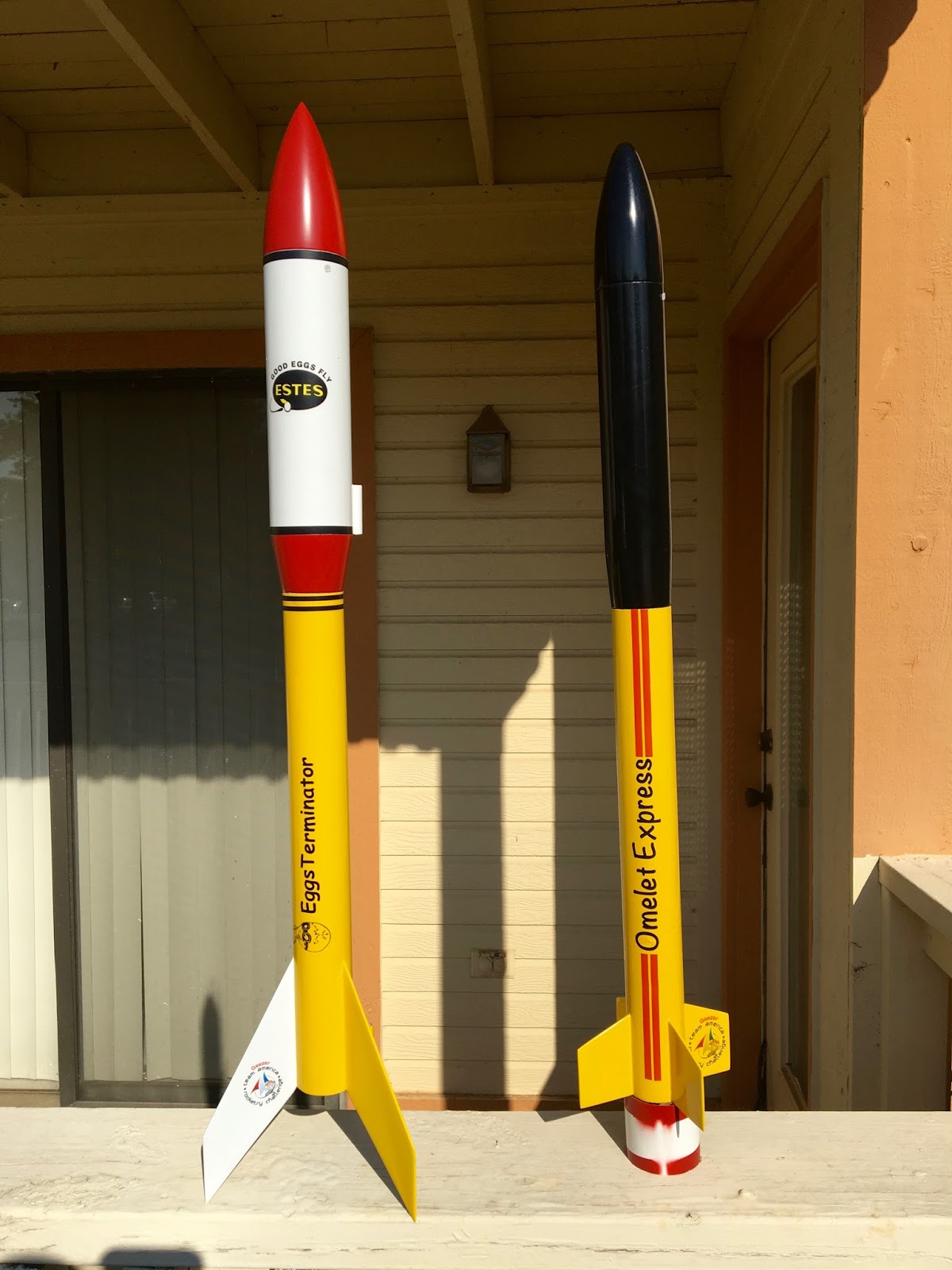
My 2017 Geezer TARC birds - the 24mm powered EggsTerminator (BT-60 to BT-70) and
the 18 mm cluster Omelet Express (BT-60 to ST-18; Click to enlarge).
I would not fare much better; my E12 powered EggsTerminator performed better than simulated, achieving an altitude of 938 feet, 163 feet above the mark. The duration, 49.8 seconds, was also on the long side due to the higher apogee. Staring at the dismal 190 score, I consoled myself with two thoughts - 1) I was ahead of Duane, and 2) the descent rate was about right. I figured the rocket would have stayed aloft for 41 seconds if it had hit 775 feet dead on.

Marc ended the first round with his "conventional" rocket. It reached 731 feet, far closer to the mark than the first two models, and was down in 29.4 seconds - about 12 seconds short on the duration. This was still good enough to put him in the lead, with a 90.5 score.

We began round 2 enlightened with the knowledge that, even with our years of TARC experience, our  scores sucked greatly, being representative of the first flights of a first year team. Very humbling.

Duane's chance for redemption and retaining his title flopped; the duration, measured at 53.5 seconds, was over 10 seconds beyond the mark, and the apogee was still 173 feet low; the rocket struggled up to 602 feet. The 215 score put the two year Geezer TARC champion in last place.

My Omelet Express flew next. Propelled by a cluster of 3 C6-5's, it soared to 763 feet, just 12 feet shy of the magic 775. However, the 12" parachute proved a bit too big for the minimum diameter egg capsule, which descended at a slow 18 feet per second. The flight duration was a long 51.7 seconds, but it was close enough to yield a score of 46.7, the best of the day. Unfortunately, the sustainer parachute was singed by the ejection charges of the the 3 motors (too little wadding) and did not open, resulting in a hard landing. Rules are rules, and so I had to disqualify myself. Nonetheless, I was pleased that my much-ridiculed black powder cluster performed better than any other rocket in the competition. And you can bet that next time I will stuff more wadding into that damn tube.

Marc ended the competition by launching his "complex" rocket, which featured onboard electronic smarts to automatically reef the parachute if the descent rate was too low. This setup was never tested, as the fly-away rail guide attached to the rocket jammed in the rail and broke free, sending the model skidding across the field. No score, a disqualification, and a badly damaged rocket. Surprisingly, the egg (and the electronics) came out of the wreckage unscathed.

The 2017 Geezer TARC champion with his daughter and trophies. Congrats Marc!
(Click to enlarge)
Thus it was, after 2 rounds, Geezer TARC had a new champion - Marc Loertscher. And in an additional bit of irony, he also received the Flying Pig Award for the worst Geezer TARC flight, as well as the winner's trophy. Congrats, Marc! You were the best and the worst! I will say Duane yielded his title very graciously; perhaps it was because he was still scratching his head over why his rockets failed to make altitude.

Duane launches his "altimeter test vehicle" (Click to enlarge).
Ever the engineer, Duane flew his "altimeter test vehicle" on an F motor; designed to check altimeter consistency, it was loaded with 6 altimeters from various manufacturers, which made an awful din with their constant chirping. Next was his upscale Cherokee-D, which was borne aloft on the flames of 3 Estes E9-6 motors. This was Duane's first cluster, and I was pleased to see it perform flawlessly; obviously hanging around me has rubbed off in a positive way.

Duane's clustered upscale Cherokee-D streaks skyward on 3 E9 motors (Click to enlarge).
It was 3 PM, and unbearably hot. We declared the Geezer TARC launch over and headed back to our air conditioned homes and college football on the TV. Hopefully there will be better scores next year!

The embarrassing scores of this year's Geezer TARC (Click to enlarge... On second thought, don't).

Friday, August 12, 2016

Of names and paint schemes...

In every TARC season, you will find a team named "Generic School Team #1" among the Falcon Rocketeers, Jurassic TARC, Team Bazinga, and the Flying Circus. I must confess that I find this a bit annoying, as I am a firm believer in TARC teams - and their rockets - having names; without names, there is no team spirit, no passion, no commitment. "Generic School Team #1 flying rocket #1" doesn't cut the mustard; it has no soul and it is hard to envision this team being successful. However, "The Flying Circus launching Baron Eggster" just screams potential greatness. Names are important, as they impart a sense of identity to the team and personalities to the rockets. In my list of priorities, a team should  make choosing its name #1, right after formation, and the rocket should be named no later than after its first flight.

Which brings me to my Geezer TARC rockets. As mentioned in a previous post, I have two awesome designs, a 3 motor cluster minimum diameter beauty and a sleek 24 mm powered bird with a BT-70 based payload section and upscale Alpha fins. The latter had no name, whereas the former I had tentatively christened Agamemnon, after the mythical Greek king of Trojan War fame. However, the more I thought about it, the more I didn't like Agamemnon; it sounded very unTARC-like. So, I did a little more thinking, and finally hit upon a new name for this rocket - the Omelet Express. Very appropriate, considering the small diameter of the payload section doesn't leave much room for cushions for the egg. 

The name for the second rocket came quickly after Omelet Express... The sims revealed that the best motor for achieving the altitude goal was the CATO-prone Estes E12-6, which is infamous for blowing rockets into tiny bits of flaming wreckage. This brought to mind images of the destruction that accompanied the Terminator in the movies, so TARC rocket #2 shall henceforth be known as the Eggsterminator.

Names assigned. Now for the hard part - the color scheme for each rocket.

Having no sense of style, I suck at colors. That's one reason why I like building kits and clones so much - I can simply duplicate the kit cover art or catalog paint scheme and save myself many hours of agony trying to figure out what color combination looks good. After spending a couple of  frustrating hours surfing the net for good TARC rocket color combos, I realized that I could simply look through old catalogs for roughly similar designs and adopt those schemes. The Eggsterminator was easy - it looked like the upper stage of the Estes Farside-X, so it will have the red, yellow, white, and black decor of that model. The Omelet Express will sport the yellow and black scheme of the Estes Scrambler 2, an egglofter kit produced back in the 80's. Both of these are high visibility, which will make it easier to see the rocket against the sky while in flight and on the ground after landing. Colors to avoid are light blue, green, and above all, camouflage. I actually encountered a TARC team who painted a camouflage scheme on their rocket; they lost it on the second flight. Needless to say, lots of white is also not good for rocket visibility - too easy to loose track while in the air.

The Omelet Express (Click to enlarge).
The Eggsterminator (Click to enlarge).
The Omelet Express and Eggsterminator are in primer. Having settled on paint decors, I now need to get cracking on making some decals.

Sunday, August 7, 2016

A special club meeting...


On Thursday evenings from mid-March to mid-October, the U.S. Space and Rocket Center hosts a biergarten dinner in the Davidson Center underneath the giant Saturn V - A perfect combination of beer, german food, and giant rockets. One of the really neat things about the biergarten is that the Space and Rocket Center donates a share of the profits to the charity or non-profit selected as the focus of that evening's event. Thanks to the efforts of Daniel Cavender, this past Thursday featured HARA as the benefiting organization; naturally, we were there in force, and had the privilege of displaying some of our models among the giant beasts of the past. We answered questions and showed our wares for about 3 hours to a crowd of 700+ folks, who stopped by our tables on the way to the booze and food. Closing time (7:30 PM) came pretty quickly, after which we held our club meeting in the shadow of the Saturn V. How many clubs get to do that?

Curious space campers eye a 3-D printer making a simulated engine bell (Click to enlarge).
Dan Cavender's excellent Jayhawk and Little Joe II HPR models on display (Click to enlarge).
Food and booze underneath the Saturn V (Click to enlarge).
One of the best club meetings ever! (Click to enlarge).
And to add icing to the cake, we got a little extra money for the club treasury. Eat your hearts out, fellow rocketeers!

Also not a bad way to celebrate my birthday...