A lot of rocketeers are talking about a recent TV commercial that features model rockets. We are used to the occasional appearance of rockets on TV - in a "Wonder Woman" episode, occasionally showing up in "The Big Bang Theory", and in an ad by Enterprise Rent-A-Car:
The recent ad is a Jardiance commercial, featuring the goings-on at a rocket fair (Cool idea, btw). It is a full minute of rocket goodness - Check it out here.
Can you name some or all the rockets you see in the ad? If so, post a comment so we can all be amazed by your rocket identification skill!
Sunday, May 17, 2020

Wednesday, May 13, 2020
Another 4th of July rocket...
Every year I make an effort to build a patriotic-themed rocket to commemorate Independence Day. Last year, it was an Estes America, and here are a few more from previous years. All this stuck-at-home stuff got me wondering what I was going to build this year, so I began to browse through my collection to find something appropriate. The search did not take long.
Back in 1986, Estes phased out its much loved (at least by us old guys) Estes Aerospace Club (EAC). it was replaced in 1988 by the Estes Space Program, which was, in my opinion, a stripped-down version of the EAC - not as much cool stuff. But like its predecessor, the Estes Space Program introductory package came with a "special" rocket - the patriotic Yankee Clipper, which looked snazzy with its red, white, and blue decor. In actuality, it was a recolored Estes Cougar, released a few years earlier in 1984, but I still liked the Yankee Clipper's style. So I opened the Estes Space Program bag and pulled out the parts. They were all there, so I am good for the build.
But first, I had to run a few simulations...
The Yankee Clipper is a simple 4FNC (4 fins and a nose cone) bird, so entering the various parts into Open Rocket was a snap. The only tricky part was getting the decal (stickers - yuck!) scan into the program to complete the decor. But my Open Rocket kung fu is pretty good, and I finished the simulation in about 45 minutes. The flight numbers show a range of altitudes between 290 and 1070 feet with conventional Estes motors; I think she'll do her maiden voyage on a B6-4 (Imagine that!).
The choice is made. Now it's time to start work on this model...
Back in 1986, Estes phased out its much loved (at least by us old guys) Estes Aerospace Club (EAC). it was replaced in 1988 by the Estes Space Program, which was, in my opinion, a stripped-down version of the EAC - not as much cool stuff. But like its predecessor, the Estes Space Program introductory package came with a "special" rocket - the patriotic Yankee Clipper, which looked snazzy with its red, white, and blue decor. In actuality, it was a recolored Estes Cougar, released a few years earlier in 1984, but I still liked the Yankee Clipper's style. So I opened the Estes Space Program bag and pulled out the parts. They were all there, so I am good for the build.
 |
| Estes Space Program page from the 1988 catalog (Click to enlarge). |
The Yankee Clipper is a simple 4FNC (4 fins and a nose cone) bird, so entering the various parts into Open Rocket was a snap. The only tricky part was getting the decal (stickers - yuck!) scan into the program to complete the decor. But my Open Rocket kung fu is pretty good, and I finished the simulation in about 45 minutes. The flight numbers show a range of altitudes between 290 and 1070 feet with conventional Estes motors; I think she'll do her maiden voyage on a B6-4 (Imagine that!).
 |
| Open Rocket simulation of the Yankee Clipper (Click to enlarge). |
Tuesday, May 5, 2020
Listening to podcasts...
As I enter my 8th straight week of telework, I have become bored by my music playlists, so I have started to listen to a few podcasts to provide some variety. The list includes a couple of my faves, The Rocketry Show, and its recent spin-off, The Model Rocket Show. Old or young, newbie or expert, if you are a rocketeer, you ought to listen to these podcasts - they are really nice!

The Rocketry Show (now in season 6) is hosted by Cornelius Gould (C.G.), Jim Seibyl (Gheem), and Daniel Petrie (the Rocket N00b), with Jesse Ulibarri recently joining the cast while Daniel is focusing on The Model Rocket Show podcast. The show varies from episode to episode - sometimes there is an interview with a well-known rocket expert or manufacturer, sometimes you have launch or event coverage, and sometimes there is interesting rocket chat focusing on a few topics and some viewer questions - "workshop talk." Up until the beginning of season 6, The Rocketry Show tried to cover all aspects of rocketry (and they achieved a pretty good balance, btw), but I think they wisely saw the difficulties in trying to cram all of rocketry in one podcast, and so Daniel spun off The Model Rocket Show to cover LPR/MPR, leaving The Rocketry Show to focus on HPR, advanced rocketry, and STEM. And so the last few episodes of The Rocketry Show have featured discussion of rocket avionics (C.G. is an electronics wizard), an interview with Jeff Skinner of Mach 1 Rocketry (can you believe BT-20 fiberglass kits?), High Power Rocket safety, and some of the new features in Rocksim 10. If you check out the show archives, you will find a pretty impressive list of topics covered in the past seasons.

Daniel is just getting The Model Rocket Show fired up, with 3 casts so far - a premier episode, followed by the story of how he got into rocketry (in a somewhat unconventional way) and a discussion of FlisKits and their products (includes interview bits with Jim Flis and the new owners). It's a great beginning and I look forward to the next episode. Daniel has a good style and a knack for picking relevant topics to us LPR/MPR folks - his blog is proof of that.
Since they are "sister shows", episodes of The Model Rocket Show and The Rocketry Show will be released in a staggered fashion to avoid conflict. Needless to say, I like this arrangement very much, because I now have two quality rocket podcasts to listen to.
Here are the links to the podcasts' webpages (they are also available on Spotify, TuneIn, Apple, etc.):
The Rocketry Show: https://www.therocketryshow.com
The Model Rocket Show: https://themodelrocketshow.com
Give them a try (do you have something better to do in the current pandemic?), and if you like them as much as I do, throw them a little support by donating thru Patreon. A few bucks can go a long way, especially if all the listeners contribute. The hobby needs podcasts like these, so let's help keep them going!
Thursday, April 30, 2020
Some launch pics...
Anyway, I figured I'd make the first post of 2020 a small pictorial of launch images of the year to date. So, without further adieu, here they are:
 |  |
| My Estes MAV on the pad (Click to enlarge). | ... and lifting off on a C6-3 (Click to enlarge). |
 |  |
| Duane's upscale Cherokee clears the rail under F42 power (Click to enlarge). | My Centuri Taurus clone gets going on a B6-4 (Click to enlarge). |
 |  |
| Jurassic TARC gets ready to launch their rocket (Click to enlarge). | Ignition of the B6-4 in my Estes Starship Octavius (Click to enlarge). |
 |  |
| The Urban Astronaut's TARC rocket under power. Note the Blue Origin rocket engine factory across the street (Click to enlarge). | Allen launches his venerable Estes Mercury Redstone (Click to enlarge). |
 |  |
| The E12 motor in Josh's Estes Blackstar Voyager leaves a nice cloud of smoke at the pad (Click to enlarge). | Duane's Death Star begins another C6-3 powered journey. It is always a crowd pleaser when it breaks apart at ejection (Click to enlarge). |
 |  |
| My ASP Corporal on a D12-5 (Click to enlarge). | And coming down under parachute (Click to enlarge). |
 |  |
| Duane's Leviathan rides the nearly invisible trail of an Aerotech F52 (Click to enlarge). | The A3-4T mini motor in my Estes Little John starts smoking (Click to enlarge). |
 |  |
| A Mammoth spewing purple flame from its Aerotech F32 motor (Click to enlarge). | The Mammoth safely descending under parachute (Click to enlarge). |
 |  |
| Duane's Mega Mosquito reaches the top of the rod, propelled by an Estes D12 (Click to enlarge). | My Centuri MX-774 clone just before liftoff (Click to enlarge). |
 |  |
| Allen's QCC Explorer heads skyward (Click to enlarge) | My Rocketarium Viking 7 scale model on 2 B6-4's (Click to enlarge). |
 |  |
| A semi-scale model of Musk's Starship heads up the rod on an Estes D12 (Click to enlarge). | A Mercury Redstone about to make a soft landing (Click to enlarge). |
 |  |
| Allen's Patriot does a shimmy before going unstable on a D13 reload (Click to enlarge). | My Estes Starbase Starcruiser makes its maiden voyage on a B6-4 (Click to enlarge). |
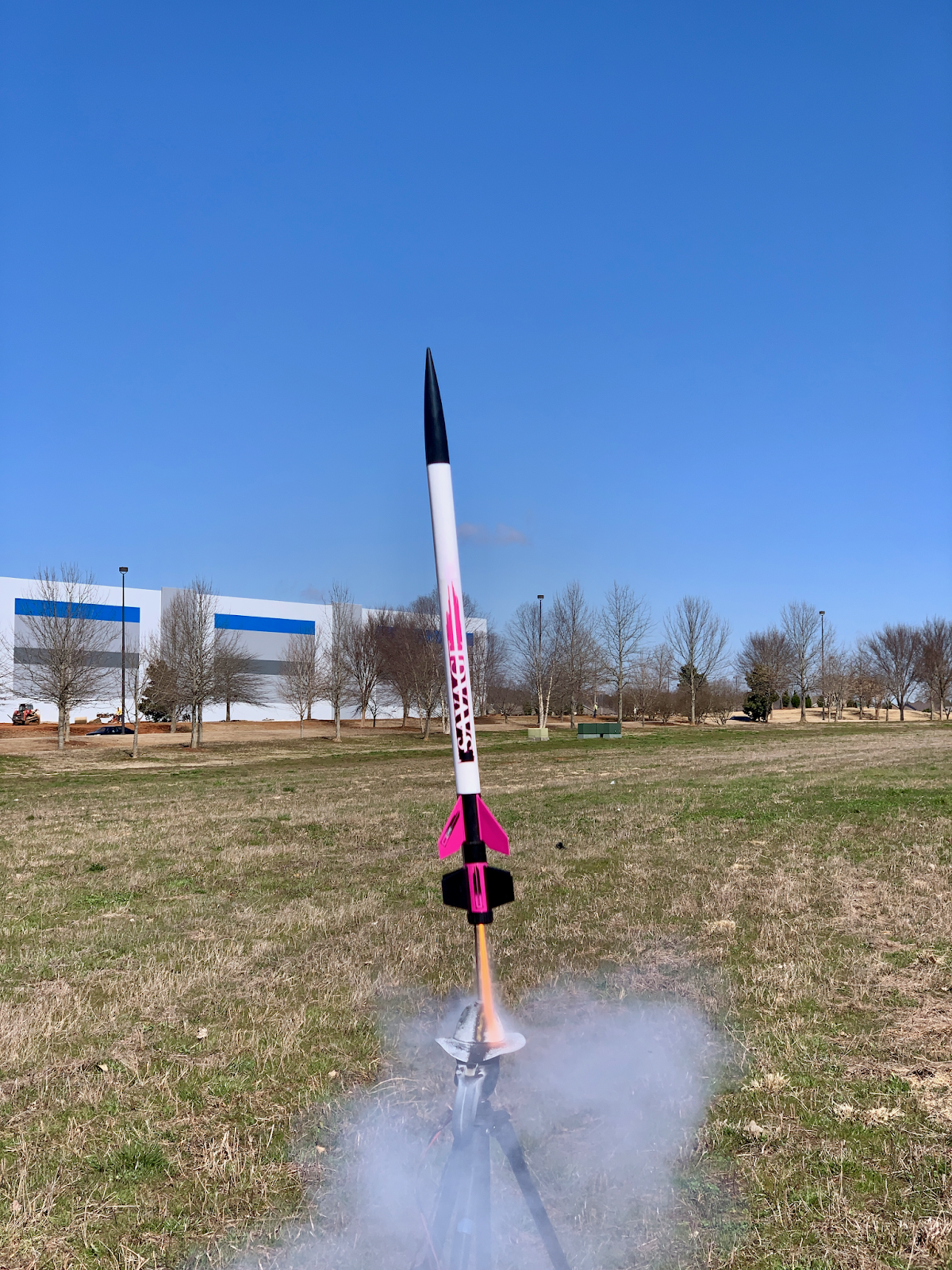 |  |
| 2 stage Estes Savage with a C11-0 in the booster and a B6-4 in the upper stage (Click to enlarge). | The B6-4 in my Quest Thunder emits a burst of flame at ignition (Click to enlarge). |
Saturday, December 28, 2019
Christmas rockets!
 |
| The Christmas rockets start appearing on the table! (Click to enlarge) |
 |  |
| The judges look over some of the entries (Click to enlarge). | Martin's winning entry (Click to enlarge). |
My venerable Polar Express started the launch a bit after 10 AM. Even though he was not riding a custom bird, Santa has flown in December over the past several years and I was not going to let him off the hook this Christmas. The black powder Quest A6-4 provided him with a decent ride and his rocket sled descended safely to the ground under parachute, ready to be refitted for next year's journey. Duane followed with his "Snowman on a stick", which powered off the pad under a D12-3. A straight flight, but the shock cord broke and the sustainer tumbled to Earth, breaking a fin upon impact. Easily repairable.
 |  |
| My Polar Express lifts off (Click to enlarge). | Duane sets up his "Snowman on a stick" (Click to enlarge). |
 |  |
| Josh's Christmas Wreath lifts off Duane's pad (Click to enlarge). | Vince's Christmas Tree starts its dance in the sky (Click to enlarge). |
 |  |
| Josh's Christmas candle takes to the air (Click to enlarge). | Patrick shows off his flying Christmas present (Click to enlarge). |
 |
| The Christmas present in flight (Click to enlarge). |
Saturday, November 30, 2019
A BT-20 sized, bluetooth altimeter for $20? Take my money, please!
Nifty product and some very cool upcoming products from FlightSketch.com. This dude has the right attitude!
From his FaceBook post:
From his FaceBook post:
As promised, I wanted to share some info on what is in store for 2020 from FlightSketch.
First up, it’s been a long road getting the Mini to production and at every step it seems like someone has asked “why doesn’t it do ........” And well, there were a few awesome features that just wouldn't fit. In order to meet the size and price targets for the Mini, a few things got left out. The biggest being deployment events. So, we are announcing the FlightSketch Sport. All of the capability of the Mini plus a 2 channel deployment controller. It’s the same width as the Mini (fits in 18mm tube) and 2" long. Single cell LiPo operation opens up dual deploy to many more models. The first flight on the sport was a BT-55 model on a C6-5!
Example flight: https://flightsketch.com/flights/347/
Example flight: https://flightsketch.com/flights/347/
Second, almost as many people have asked for the opposite - an even smaller altimeter for competition use. We shaved 30% off the mass of the original FS Mini but the question was still “how low can we go?” Introducing the FlightSketch Competition. A sub-gram recording altimeter that is just 8mm wide and with all of the features of the Mini including Bluetooth. Small enough for record setting flights in the smallest models, we will be pursuing NAR and FAI approval for contest use.
And one more thing... like many others, we’re tired of spending hours searching for models after landing. Even low power models in tall grass can be impossible to find. It’s (almost) 2020, why can’t I just get a map to my rocket? Introducing FlightSketch SST - the Super Simple Tracker. Still just 0.6 inches wide, fits in an 18mm tube and plots your rocket’s position in real time on Google Maps. Uses Ublox GPS with LoRa radio technology for incredible range without external antennas. We maxed out our line of sight test capability at 16.5 miles with still a few dB of link budget left. And most importantly, it will be the most affordable tracking system available. Screen shots show the range test and an actual flight.
Stay tuned for more updates. Please let us know what features you would like to see!
Thanks for all of your support, looking forward to another amazing year!
 |
| Click to enlarge. |
Sunday, November 17, 2019
Caught launching rockets...
Now under construction on the old Pegasus field, the Blue Origin rocket engine plant is very big and impressive; I am always amazed at how quickly these buildings are built. They seem to spring up overnight, like the walls just popped out of the ground. I hope Blue Origin give tours once the plant becomes operational, as I'm sure there is going to be some cool stuff to see within those walls.
Anyway, yesterday Duane brought to my attention an article about the plant construction that appeared in local paper and on AL.com. He pointed out that there was an aerial photo of the plant, which captured us launching rockets on the field across the street earlier this month. I looked it up on the Internet, and sure enough you can see Duane's SUV out in the field. Pretty cool.

You never know who is going to be watching when you fly rockets!
Subscribe to:
Posts (Atom)