Thursday, September 17, 2015
Help find a cure - buy a rocket!
Quest Aerospace is offering a pink and red version of its old Big Rage rocket for just $10! Part of the proceeds go to raising breast cancer awareness through the It's the Journey foundation. A very easy to assemble rocket that stands over 3 feet tall, plus making a contribution to the fight against cancer! What are you waiting for? Order one (or two, or three, or ...)!
This thing looks perfect for those evil Hello Kitty decals and stickers, btw.
Friday, September 11, 2015
Confused by light?
I continued to ponder why the Perfectflite PNUT flown in Probe-18 on Saturday had ground level at -65 feet. I am not an electronics type of guy, so I did what any nerd seeking enlightenment would do - I contacted tech support:
Additional Perfectflite suggestions:
Sir,
I experienced my first ever anomaly with a Perfectflite altimeter at this past Saturday’s launch. In brief, it seemed to think ground level was at -65 feet, and underreported the altitude by that amount (as compared to another altimeter in the same payload section). I have a post describing this on my blog:
http://billsrockets.blogspot.com/2015/09/altimeter-funny-business.html
and have attached the data file to this email. Any insight/help you can give would be greatly appreciated.
Kind regards,
Bill Cooke
Perfectflite responded in a day with this very informative post, which gives a lot of insight into the workings of the PNUT:
Hi Bill
The Pnut does not start recording at T = 0 & Alt = 0. After you turn it on and wait for the init procedure, it constantly samples pressure and fills several circular buffers. One buffer records the last 32 altitude readings (MSL, or above sea level, not ground level) to provide pre-launch data. The other buffer stores averages of the contents of the first buffer to track the ground elevation which can change due to weather variations if the rocket sits on the pad for an extended time. The averaging also minimizes the impact of sensor drift and wind gusts.
The altimeter detects launch when the current altitude reading is 100 feet higher than the averaged ground elevation (this launch detect threshold is changeable from the download software, 100' is the default). The program then copies the last 29 readings into the flight memory and continues sampling and recording data from that point. So the bottom line is that you get about 1.4 seconds of data preceding the 100 foot altitude point, which will not necessarily mean that T=0 on the graph will be at altitude = 0. If the rocket takes off quickly, you will have a number of altitude = 0 readings stored before the curve starts upward. Similarly, if the rocket has a slow ascent, the T=0 altitude will be greater than 0. With a 100 foot launch detect, as long as the rocket's average speed is above about 70 FPS you will be assured of getting data extending back to the liftoff point.
The above is just an explanation of the fact that T = 0 and altitude = 0 do not coincide (so we can record and display some pre-liftoff data), it has nothing to do with explaining your anomaly.
The second buffer averages the MSL readings from several seconds prior to the current point in time back to about 26 seconds prior to the current time. The produces the stabilized ground elevation that the altimeter later uses to convert MSL readings to AGL (above ground level) readings. Because the average is based on a "moving window" that is updated continuously, effects of sensor drift and weather variations are essentially eliminated. Because it is an averaged value based on a large number of samples, noise due to wind gusts or other anomalies is also reduced. If you just sampled the ground elevation once when the altimeter was turned on and the rocket sat on the pad for 30 minutes before launch (not uncommon...) then the sensor drift and weather issues could be quite large. If you just take a single sample every so often to update the ground elevation (without averaging), then a wind gust at that particular point can shift the ground elevation significantly, potentially leading to false launch detect and large errors in the ground elevation.
As soon as the altimeter detects launch (altitude greater than 100 feet and T=1.4 seconds) the ground elevation averaged from the period 3 seconds earlier to 26 seconds earlier is "locked in" and is never subject to change. The large ejection spike occurs well after that point, so it has nothing to do with the issue.
So something during the period of 3 seconds to 26 seconds prior to launch detect had an enormous impact on the ground elevation. If it was a brief event, the magnitude would have to be huge to shift the average of nearly 450 samples by 65 feet.
Is it possible that sunlight entered the payload bay's vent holes (i.e. are any lined up in such a way that this could be possible)? If your Pnut is one with the newer stainless steel covered pressure sensor (U3 on the bottom of the unit) then one of the sensor's holes should be covered with a small black piece of tape. If the tape has been dislodged, then the sensor will have a large degree of light sensitivity and a hit by direct sunlight could easily cause the issue you describe. If you have the older sensor with a white plastic cover, light sensitivity is not a problem.
Can you email a sharp closeup of the bottom of the altimeter?
Also, the difference in magnitude of the ejection spike is easily explained by the fact that the spike is very brief (less than 1 sample in duration) and the Pnut samples at 20 samples per second vs. the MicroPeak 10 sample per second. Unless the two devices were in perfect synchronization, they would be sampling different pressures due to the rapid change in pressure during the spike.
The paragraph highlighted in bold is what surprised me - a light-sensitive pressure sensor? I hauled out the PNUT and took a close look:
![]() |
| Bottom of PNUT altimeter (Click to enlarge). |
Sure enough, there was no tape covering one of the holes (I have no idea which one is supposed to be covered). So that seems to be it - light entering the payload section and hitting the sensor caused ground level to be reset. Who would have thunk?
Perfectflite, being a class act, offer to repair and clean the altimeter if I return it to them, which I will do next week. Hard to turn down an offer like that. They also gave me a couple more tips, which I am posting below for those who may find them of use. Technical support (except for Apple Genius Bar) is good - a couple of emails yielded a plausible answer to my mystery.
Additional Perfectflite suggestions:
1) A large downward ejection spike is usually caused by ejection charge gas entering the payload bay because of insufficient sealing. Since the gas is corrosive, this can cause degradation of the electronics. Are there any holes or other possible leaks in the balsa coupler depicted in your drawing? Or is the balsa that porous?
Bill's note - nope, there are no holes or leaks in the coupler, which is a nice 1.5" length cylinder of good quality balsa. Has a nick in the bottom after this flight, but still AOK)
2) Your static ports don't need to be anywhere near as large as described on your drawing (four 1/8" holes). Four pinholes made with a standard pin would be more than enough, and using a pin is fast & clean. The smaller holes would also minimize sunlight effects and provide filtering of wind and turbulence for a smoother graph.
Monday, September 7, 2015
Altimeter funny business...
Rocket geeks like to know how high their birds fly; over the decades, we have gone from "just guesstimating" to visual tracking with theodolites and trig tables to the tiny barometric altimeters made possible by modern electronics. Most of us - with the exception of a few contest rocketeers - would agree that the trend has been towards increased accuracy and greater precision. Altimeters are now legal in contest events and the qualification scores of TARC teams are dependent on the beeps or flashes emitted by the devices. However, I am often curious as to the accuracy of the altimeters we use; I would guess about a few feet if everything goes normally, but that is a just a "guesstimate". So, being a nerd, I decided to fly 2 altimeters (Perfectflite PNUT, Altus Metrum Micropeak) in the payload bay of Probe-18 at Saturday's HARA launch. Lofting small payloads was what the rocket was designed to do, and I figured the comparison would be useful, fully expecting the altimeters to agree within several feet.
When the rocket was recovered, the PNUT was beeping out a peak altitude of 257 feet, which seemed a bit low, but, hey, my eyes aren't calibrated. I did not bother to check the MicroPeak until I returned home, at which point I downloaded the altitude profiles from both altimeters. Boy, was I surprised! The MicroPeak recorded a peak altitude of 322 feet, a whopping 65 feet higher than the PNUT value - what was going on?
Both profiles were similar in that they showed a huge altitude dip at ejection, characteristic of a pressure increase associated with the Estes shotgun ejection charge. That much I could explain. Looking closely at the PNUT profile, I saw that it did not start out at 0 feet at 0 seconds, which was unusual. I then checked the profile from a second PNUT that had flown aboard Nemesis at the same launch; that profile looked normal, with the rocket lifting off and landing at 0 feet. So no insight there. I copied the Probe-18 PNUT numbers into Excel, where I discovered that landing was considered to have occurred at -65 feet altitude. Hmm... 257 + 65 = 322, the number reported by the MicroPeak. Since the MicroPeak produced an expected profile, I was inclined to take it as the "truth"; I found I had to add 65 feet and +0.3 seconds to the Perfectflite PNUT data to get a match to that of the MicroPeak.
So what's the deal here? Both altimeters were in the same payload section, with adequate ventilation to the outside air. Both showed the dip in altitude at ejection, though the PNUT had it occurring 0.3 seconds earlier and the dip more severe, going right though 0 to -112 feet. In the MicroPeak data, the dip reached 25 feet, not quite to 0. Could this somehow have screwed up the Perfectflite smarts, causing it to think the ground was at -65 feet? Or did the shock of the impact with the fin give the PNUT a "concussion"? Were my holes to the outside too big? Or was there a gremlin blowing on the PNUT, trying to mess with my mind? I then remembered a similar occurrence involving the MicroPeak back in January; it too registered a ground level well below zero feet. Back then, I attributed the anomaly to not giving the altimeter enough time to sense ground level before launch, but this time the altimeter was beeping steadily (indicating ready to launch) and the Probe-18 sat on the pad for several minutes before lifting off - Couldn't be the case here. In the January flight, it was obvious that the altimeter moved in the payload section during flight. Perhaps the PNUT was a bit loose and shifted around in the Probe-18's payload section?
Whether it was a mistake on my part or not, this experience gives me a bit less confidence in electronic altimeters. By looking at the PNUT data, I was able to see something was fishy, and even derive the "correct" peak altitude by adjusting the zero point. But in evaluating a TARC flight, we are allowed to only use the altitude beeped or flashed by the altimeter when it is returned to the observer; no analysis of downloaded data can be used to adjust the score. How often do the altimeters beep out a wrong value?
I was wrong...
First, a bit about the flight. Probe-18 was launched in light winds on a B6-4 motor. The field was a fairly flat sod farm, with no significant rises or dips in the terrain. The rocket flew straight, with only a slight of amount of turning into the wind, and looked to have achieved an altitude of a few hundred feet. The parachute fully deployed and the rocket descended slowly; the ejection charge fired on time, though it sounded loud, indicating perhaps a bit too much powder (i.e., a "shotgun" ejection charge). After recovery, the body tube near one fin was observed to have failed, and the fin was chipped at the leading edge. Further inspection revealed a deep gash in the balsa coupler at the bottom of the payload section, suggesting that it had snapped back into the rocket at ejection, hitting the top of the fin; the force of the impact caused the body tube to fail near the fin root.
![]() |
| Probe-18 damage (Click to enlarge). |
| Probe-18 payload section layout (Click to enlarge). |
| Probe-18 altitude profile recorded by the Perfectflite PNUT (Click to enlarge). |
| Probe-18 altitude profile recorded by the Altus Metrum MicroPeak (Click to enlarge). |
| A "normal" PNUT altitude profile - that of Nemesis at the same launch (Click to enlarge). |
![]() |
| Altimeter profile comparison (Click to enlarge). |
Whether it was a mistake on my part or not, this experience gives me a bit less confidence in electronic altimeters. By looking at the PNUT data, I was able to see something was fishy, and even derive the "correct" peak altitude by adjusting the zero point. But in evaluating a TARC flight, we are allowed to only use the altitude beeped or flashed by the altimeter when it is returned to the observer; no analysis of downloaded data can be used to adjust the score. How often do the altimeters beep out a wrong value?
It makes one want to fly a second altimeter as a check. But that adds weight.
Sunday, September 6, 2015
Yesterday's HARA launch...
Saturday marked the next-to-last or last club launch in Manchester for 2015; I'm betting that it will be the last, because the sod farm folks were already re-sodding the northern part of the field. Once this gets fully underway, we will be unable to launch there until March, when the grass is grown. Nonetheless, it was difficult to get my carcass out of bed at 6:30 AM, especially after a busy week at work. But I did manage to get moving and drag my stuff outside to meet Duane at 7:30. The two hour drive to the field was normal and uneventful; I was impressed by the efficiency of the Winchester Hardee's staff in handling a very large morning crowd - we got our biscuits within a couple of minutes of ordering.
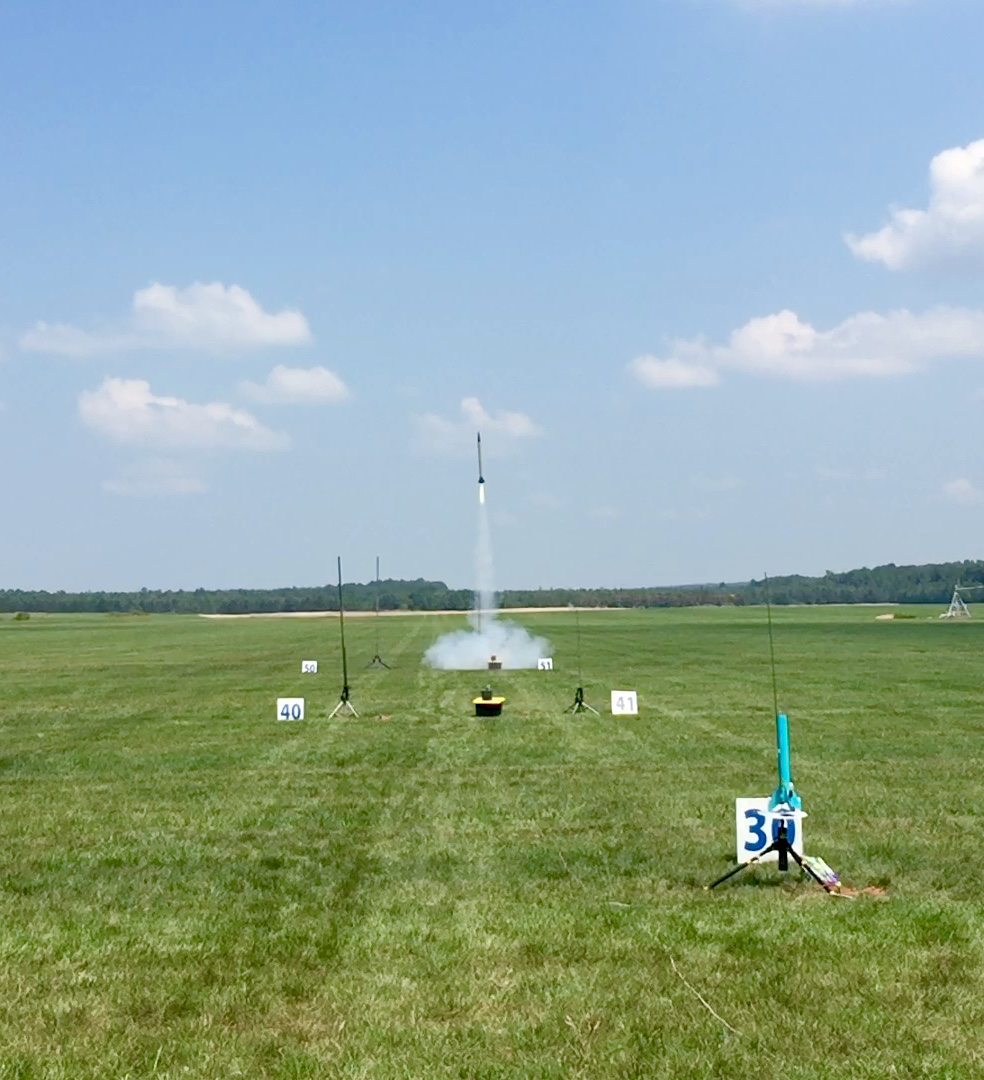
The low power pads were the most active; a 3 crayon rocket drag race and one involving 2 Estes mini motor powered ready-to-fly models delighted the crowd. The crayon drag race was especially colorful, and those crayons would individually fly several more times in the morning. Brenna Nyman flew a 3 stage mini Comanche-3, which had an issue with the upper stage, and a Red Max. Lots of other model rockets took to the air, but I was not paying much attention, being tied up with RSO (Range Safety Officer) and LCO (Launch Control Officer) duties.
A RSO is the person who checks the rocket for stability and workmanship; he or she makes sure the rocket has the fins glued on, has a recovery device, that the motor is installed properly, and that the flight card is complete. If the rocket is not a kit, the RSO also checks the rocket's stability, visually verifying that the center of gravity is forward of the center of pressure. Finally, the RSO assigns the model a pad number. The LCO is the individual who controls the range, makes the launch announcements over the PA system, ensures the range is clear, and does the actual launching. At past launches, I have performed one or the other of these duties; I took stints as both yesterday. I actually like these roles, but it does take time away from flying and picture taking. However, range duty is a necessary evil if your club is running the launch.
The net upshot was that I only got to fly 3 of the 6 rockets I had brought to the launch. The Quest Astra, Balsa Machining School Rocket, and Beulah would have to fly another day, while the Space X Falcon 9, Nemesis, and Probe-18 made their inaugural flights. In my last post, I characterized Estes E motors as "sticks of dynamite"; that was not true at this launch, where all 3 E12's I flew performed superbly. It was probably a bit too much motor for the Falcon 9, which got way, way up there; I had a very long walk to recover that one, which gently descended under a black 18" nylon parachute. Nemesis flew to 878 feet on her 2 E12 motor cluster, proving that you can achieve this year's TARC goal by clustering Estes black powder motors. My scratch-built Probe-18 model soared to 322 feet on a B6-4; however, the payload section carrying the two altimeters snapped back into one of the fins, ripping the body tube. Notice that I did not say "knocking the fin off" - the double glue joint technique produces a very strong bond; the fin will break or the body tube will fail before the fin comes loose. I am still trying to decide whether to repair the damage (which will conserve parts) or build a new sustainer (which will probably be quicker).
![]() |
| A rack of rockets ready to fly (Click to enlarge). |
I think the best word to describe this launch would be work. HARA had the range duty, and Chuck was already there unloading the trailer when we arrived. I did my customary setting up of the low power pads, leaving the mid and high power stuff to the others. We were a bit under staffed, so the range was not ready until 10:15, about 15 minutes behind schedule. This would not be a problem, as the crowd of attendees was about medium for a club launch; no one was in particular hurry to fly. The weather looked great, with a light wind out of the southeast - for once blowing AWAY from the trees. Chuck gave the flyers' briefing, and we were off to the races...
![]() |
| A successful level 2 certification flight begins (Click to enlarge). |
Just a few high power rockets would take to the skies. Art flew the largest rocket with some fancy electronics to over 4000 feet on a J motor, Tracy certified Level 2 on a J, and Keith Nyman flew his Laika on an I239 Blue Thunder motor; the rest of the high power flights used H impulse. One gentleman put an H in a 38mm minimum diameter rocket, which got some air, and then stuck an H400 into the same rocket. It streaked off the pad like a bullet, and I did not see it until it landed near the road about a hundred yards away. Another H flight netted a young rocketeer a Jr. Level 1 certification. That was about it for high power.
![]() | ![]() |
| A red and black Leviathan lifts off (Click to enlarge). | An E motor suffers a nozzle blow out (Click to enlarge). |
We had lots of mid power flights; there were several Leviathans flying on F's and G's. The Leviathan is not available from Estes any more, but it is a very popular rocket on the flight line. Duane flew his Goth Geezer TARC rocket 3 times, finally reaching an altitude of 867 feet, about 17 feet above the 850 foot goal. However, it was a good thing he substituted dummy weight instead of eggs, because the shock cord broke in each of the last two flights, perhaps cut by the end of the brass tube used in the shock cord mount. An Estes Silver Comet from the 1990's flew twice on E motors, and there were many others I cannot recall.
![]() |
| 3 Crayon rocket drag race (Click to enlarge). |
![]() | ![]() |
| Brenna's Mini Comanche-3 leaves the rod (Click to enlarge). | The first stage falls away from the Comanche-3 (Click to enlarge). |
A RSO is the person who checks the rocket for stability and workmanship; he or she makes sure the rocket has the fins glued on, has a recovery device, that the motor is installed properly, and that the flight card is complete. If the rocket is not a kit, the RSO also checks the rocket's stability, visually verifying that the center of gravity is forward of the center of pressure. Finally, the RSO assigns the model a pad number. The LCO is the individual who controls the range, makes the launch announcements over the PA system, ensures the range is clear, and does the actual launching. At past launches, I have performed one or the other of these duties; I took stints as both yesterday. I actually like these roles, but it does take time away from flying and picture taking. However, range duty is a necessary evil if your club is running the launch.
![]() | ![]() |
| My Falcon 9 blasts off on its first flight (Click to enlarge). | Nemesis' dual E12's leave behind a trail of smoke (Click to enlarge). |
![]() |
| Probe-18 heads into the clouds from Pad 10 (Click to enlarge). |
| Probe-18 altitude profile as reported by the Micropeak altimeter. The major dip is caused by the B6-4 motor's "shotgun" ejection charge (Click to enlarge). |
Around 1:30, pop-up thunder storms began showing up in the local radar, and 15 minutes or so later, the sound of thunder convinced us it was time to go. Everyone pitched in to break down the range, and we had the trailer loaded by 2:15. Rain had started to fall, bringing to an end the last HARA Manchester club launch of the season. Even if there is a launch next month, it will be the Music City Missile Club's job to run the range.
Which means I will get to focus on flying...
Saturday, August 29, 2015
Geezer TARC launch!
Well, today was the long awaited day - a bit on the cloudy side, with winds in the 8-10 mph range. However, the rain held off long enough for us to complete the Geezer TARC launch, and I must say it was interesting - for a lot of reasons.
So, where to begin? The wind was out of the South East, so we set up the range at the south end of the farm driveway. There were 5 pads - Duane's TARC rail pad, my MPR pad with a quarter inch rod, Woody's tower, Duane's wooden LPR pad, and my camera tripod LPR pad. Naturally, each pad had a controller, with the wooden LPR pad connected to Woody's crank type launch controller, which was a big hit with the kiddos that came out today. Forget batteries - they loved swiftly turning the crank to charge up the capacitors so they could launch the rockets! A classic example of low tech appeal...
The 2016 Geezer TARC contestants that showed up at the Harvest horse farm were Duane, Woody, Vince, Randy Tyler, and yours truly, which was a couple more than last year. Geezer TARC is growing and I like seeing new faces in the competition; it adds variety and increases the challenge. I wish to give a big shout out to Randy Tyler - He came all the way from Memphis to launch with us today. That's real dedication! Anyway, Duane and I had 2 rockets, Vince sort of had 2 rockets (he used the same payload section on both), and Woody and Randy each brought one. There were several non-contestants as well. Nate was there to cheer us on, despite feeling crappy, Art Woodling showed up with a couple of vintage model rockets, Woody had a few friends with their kids and rockets, and Elliot Laramie brought his son Joseph out for his first rocket launch. I do believe Joseph is going to be a range LCO in a few years - he was very enthusiastic about the launch and quickly learned how to handle the launch controllers. And I must not leave out Chuck Pierce, who arrived on the field with a Der Red Max modified to accept 29 mm motors. Mind you, I'm not talking about the big Estes Mega Red Max; this was the standard Red Max that is sent out of sight on a C6-5. I think Chuck wanted to put his up in the stratosphere, as there was serious talk of flying it on a G motor. My initial impression was that it was a goner on the first flight. Much to my surprise, I was wrong - the rocket was recovered after flights on an E30 and a F21. Der Rot G-Maximus still lives!
There were a total of 7 Geezer TARC flights, and things did not start out well. Duane was the first to launch; it was a good flight, except that he forgot to turn on his altimeter, so we had no idea of the peak altitude. It was an embarrassing moment for Mr. Check List, and I will be sure to remind him of this at the appropriate times <evil smile>. Vince flew his Frankenstein creation built of various kit parts next; unlike the rest of us, he just threw the rocket together, without simulations or anything. He had the simple goal of getting a qualified flight, but this one would not be it - the rocket got some air on an F44 motor, but the shock cord burned through. The parachute saved the altimeter and eggs, but the sustainer hit the ground hard and crumpled. Despite this disqualification, Vince was undaunted and proceeded to kluge together his next flight - Baron Frankenstein would have been pleased with the scavenging of the corpses of past kits.
Woody was up next. His rocket reached 766 feet on a F20 White Lightning motor (I love White Lightning motors - they are brilliant and loud). However, the parachute failed to deploy - ouch, and another disqualification. Randy Tyler then flew his patriotic red, white, and blue rocket on an Aerotech F32. This beauty over performed, topping 1000 feet. It looked like we were going to have our first qualified flight of the day, but alas, one egg was broken. 4 flights, 4 disqualifications. Things were not looking good.
It was time for me to get off my rear and fly one of my rockets. Nemesis, flying on 2 Estes E12's, was to be my primary bird today; however, there had been several modrocs flown off the low power pads using E's, and every darn one of the things went boom. Elliot's SpaceShip 1 had an E blow out on the pad, and Vince's (Rocketarium?) Hexagon was shredded by another E CATO as it cleared the rod. I looked at my beautiful Nemesis and thought of two of those things blowing her lower half to tiny bits. Chickening out, I switched to #2, my F powered backup. It turned out to be a good choice - #2 soared to 894 feet and was down in 56 seconds. And, wonder of wonders, the eggs were undamaged. The jinx was broken; we had our first qualified flight of the day. And with an 84 score, I was in the lead.
Vince followed my launch with Brother of Frankenstein, which also made a qualifying flight. At 41.6 seconds, the time was good, but the altitude was way low, at 656 feet. Still a qualifying flight, and Vince was happy. I was happy too, as I was in first place.
And then came Duane's last flight...
He readied his yellow and purple backup rocket, and after making sure to turn on the altimeter, placed it on the pad. The rocket blasted skyward on its F motor, achieving 878 feet, the best altitude of the day - only 28 feet over the mark. It also turned in a pretty good time - 48.9 seconds, just 2.9 seconds long. At this point, I knew I was doomed. Only a cracked egg could save me, but Duane's rockets feature his super-spiffy molded egg protectors - the rocket could come in ballistic and the damn eggs would still remain unscathed. And I was right; the eggs were undamaged. Duane now had a 39.6 score, twice as good as my 84.5. Now was the moment of decision - would I make another attempt using Nemesis?
The flying bits of Vince's Hexagon swam before my eyes, and once again, I chickened out. The glory of winning would not match the agony of seeing Nemesis blown to bits. She will fly, but only after I sim 2 D12's and 2 C6's - even though it is a 4 motor combo, it will be much safer than flying using those sticks of dynamite Estes calls E motors. Duane can claim bragging rights again this year; I'll get him next time.
So, where to begin? The wind was out of the South East, so we set up the range at the south end of the farm driveway. There were 5 pads - Duane's TARC rail pad, my MPR pad with a quarter inch rod, Woody's tower, Duane's wooden LPR pad, and my camera tripod LPR pad. Naturally, each pad had a controller, with the wooden LPR pad connected to Woody's crank type launch controller, which was a big hit with the kiddos that came out today. Forget batteries - they loved swiftly turning the crank to charge up the capacitors so they could launch the rockets! A classic example of low tech appeal...
![]() | ![]() |
| Art's 45 year old scratch build lifts off as Vince and Chuck look on (Click to enlarge). | Elliot's V-2 heads into stormy weather (Click to enlarge). |
![]() | ![]() |
| Chuck's Der Rot G-Maximus is a blur on an F21 (Click to enlarge). | Elliot and Joseph launch an Estes Ventris (Click to enlarge). |
There were a total of 7 Geezer TARC flights, and things did not start out well. Duane was the first to launch; it was a good flight, except that he forgot to turn on his altimeter, so we had no idea of the peak altitude. It was an embarrassing moment for Mr. Check List, and I will be sure to remind him of this at the appropriate times <evil smile>. Vince flew his Frankenstein creation built of various kit parts next; unlike the rest of us, he just threw the rocket together, without simulations or anything. He had the simple goal of getting a qualified flight, but this one would not be it - the rocket got some air on an F44 motor, but the shock cord burned through. The parachute saved the altimeter and eggs, but the sustainer hit the ground hard and crumpled. Despite this disqualification, Vince was undaunted and proceeded to kluge together his next flight - Baron Frankenstein would have been pleased with the scavenging of the corpses of past kits.
![]() | ![]() |
| Duane's 1st flight leaves the rail (Click to enlarge). | Vince's creation #1 starts its ill-fated journey (Click to enlarge). |
Woody was up next. His rocket reached 766 feet on a F20 White Lightning motor (I love White Lightning motors - they are brilliant and loud). However, the parachute failed to deploy - ouch, and another disqualification. Randy Tyler then flew his patriotic red, white, and blue rocket on an Aerotech F32. This beauty over performed, topping 1000 feet. It looked like we were going to have our first qualified flight of the day, but alas, one egg was broken. 4 flights, 4 disqualifications. Things were not looking good.
![]() | ![]() |
| Randy's patriotic rocket heads up into cloudy skies (Click to enlarge). | Woody's rocket clears his tower (Click to enlarge). |
![]() | ![]() |
| Vince's Hexagon is blown apart by an E motor CATO (Click to enlarge). | #2 streaks off the pad on an F32 motor (Click to enlarge). |
Vince followed my launch with Brother of Frankenstein, which also made a qualifying flight. At 41.6 seconds, the time was good, but the altitude was way low, at 656 feet. Still a qualifying flight, and Vince was happy. I was happy too, as I was in first place.
And then came Duane's last flight...
He readied his yellow and purple backup rocket, and after making sure to turn on the altimeter, placed it on the pad. The rocket blasted skyward on its F motor, achieving 878 feet, the best altitude of the day - only 28 feet over the mark. It also turned in a pretty good time - 48.9 seconds, just 2.9 seconds long. At this point, I knew I was doomed. Only a cracked egg could save me, but Duane's rockets feature his super-spiffy molded egg protectors - the rocket could come in ballistic and the damn eggs would still remain unscathed. And I was right; the eggs were undamaged. Duane now had a 39.6 score, twice as good as my 84.5. Now was the moment of decision - would I make another attempt using Nemesis?
![]() |
| 2016 Geezer TARC results (Click to enlarge). |
![]() | ![]() |
| Duane Mayer - Geezer TARC champion for the 2015-16 season (Click to enlarge). | Vince Huegele gets the Flying Pig Award for proving you can qualify with corpses of old kits (Click to enlarge). |
Thursday, August 27, 2015
Ready to fly!
At long last, after battling with a sprained wrist and stormy weather, my 2016 Geezer TARC rockets are painted, decaled, and ready to fly. The red and white Nemesis is my primary bird for this Saturday's launch - a 4 motor cluster, she is also the heaviest TARC rocket I have ever designed. Fully loaded with eggs, altimeter, and motors (two E12's and two C6's), she weighs in at 620 grams, just 30 grams under the limit. However, Open Rocket tells me I should be able to reach the 850 foot altitude goal with just the two E12's, which gives me a little more margin in weight and reduces the "pucker factor" associated with trying to ignite 4 motors simultaneously. I am still nervous about using the E12's, though - they have a relatively high CATO rate.
The backup is the old #2. He is pretty conventional, with a standard 29mm motor mount. He is also smaller and about 30 grams lighter than his sister. The limited selection of single use motors means that I am going to have to add about 70 grams of weight to keep from majorly overshooting altitude; otherwise, a F is going to put #2 way, way up there.
The launch begins at 10:30 AM this Saturday - it's going to be interesting!
![]() |
| My 2016 Geezer TARC rockets (Click to enlarge). |
The launch begins at 10:30 AM this Saturday - it's going to be interesting!
Sunday, August 16, 2015
Full production at the rocket factory...
Now that I am done with travel for a bit, I can spend some time building rockets. This is a good thing, because the Geezer TARC launch is just around the corner! The wrist I sprained while in California is still giving me a bit of trouble, but I have managed to get two TARC birds built and into the final stages of finishing. The 4 motor powered Nemesis is ready for her first coat of paint, whereas my backup rocket - appropriately named #2 - is in its first coat of primer. #2 is a pretty conventional TARC design, made of standard BT-80 tubes (2.6" diameter) and uses a single 29 mm motor; he will fly, though I am struggling with the proper motor/weight combination. Weather looks stormy this week, so it will probably go down to the wire as far as getting these rockets all painted and decaled.
Joining the TARC rockets in primer is a clone of the old Estes Sizzler (#1906) and a starter kit from Quest, the Astra. I am a big fan of Quest designs, but the kit components can be less than - which is why I would hesitate to use the Astra in a beginning rocket class. The motor tube is flimsy, the body tube has deep spirals, and the laser cut fins are too big to fit in the slots on the tube, requiring a fair amount of sanding. Not much fun for a beginner, especially when you compare it to the BMS School Rocket, or even the venerable Estes Alpha.
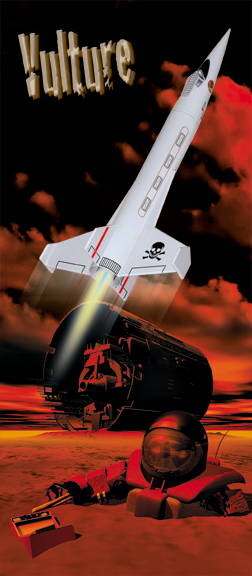
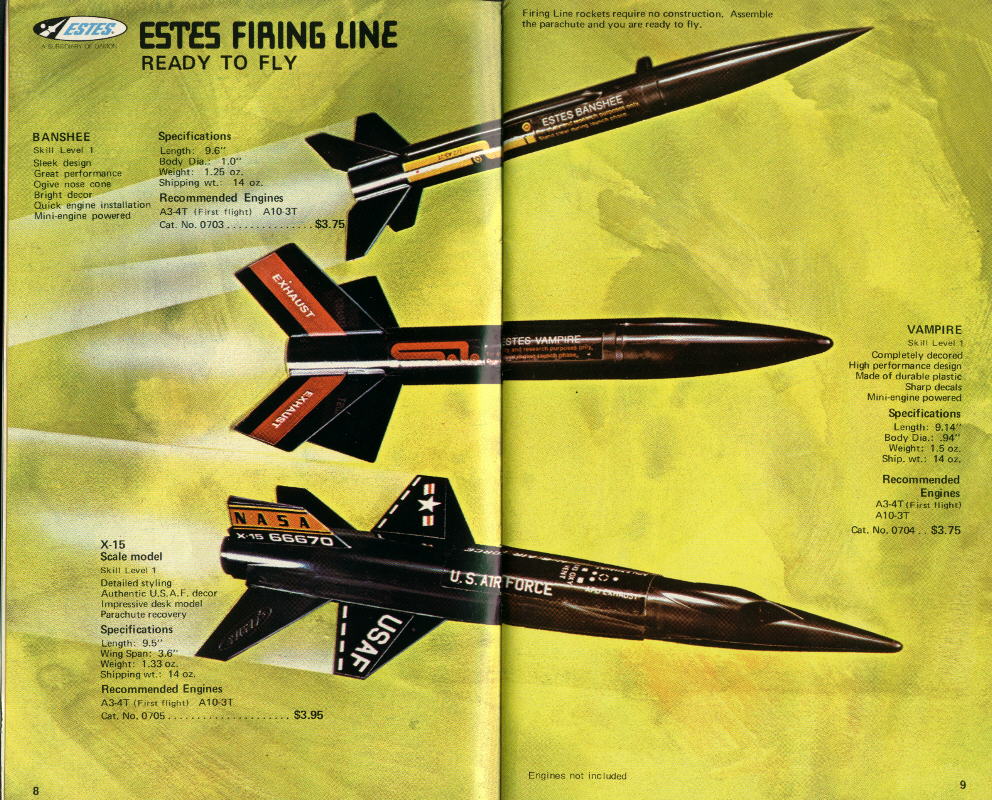
I am also working on a couple of other kits - a Squirrel Works Vulture, which is now ready to have the wood parts sealed and sanded smooth, and the re-release of the Estes Goblin, which I threw together watching Star Trek and Svengoolie last night. It will be ready to go to finishing once I have filleted the fins with wood glue. Building the Goblin has sparked an anticipation of Halloween - I think my next build will be a clone of the old Estes Vampire, to keep the Goblin company. I have the dimensions, and I am pretty sure I have the parts to make a very close replica of this all plastic model, which was part of the Estes Firing Line series (1973-1976).
I did a check of this year's builds against the list I made last October. I have finished the Big Bertha, Beulah, Centuri Micro Probe, Space X Falcon 9, and Scrambler; have not done the Gyroc, S.S. Cestris, Orbital Transport, and the Tiny Tim scale model. 5 out of 9 complete - not too shabby given my rocket ADD. Still have about a month and a half till October, so I may get one or two of the remainder built; you never know.
Lists are only guidelines anyway.
![]() |
| From left - #2, Nemesis (in white primer and 2 pieces), Quest Astra (in back), and Estes Sizzler clone (Click to enlarge). |
| Squirrel Works Vulture (from the Squirrel Works web site). |
| Estes Sizzler in the 1985 catalog (Click to enlarge). |
| Estes Vampire in the 1974 catalog (Click to enlarge). |
Lists are only guidelines anyway.
Subscribe to:
Posts (Atom)