Thursday, February 10, 2022

Sunday afternoon launch

Girl scouts watch as the rocket they prepped heads skyward (Click to enlarge).

The John Paul II TARC teams had scheduled a TARC practice for this past Sunday, which provided a perfect excuse for some of us to drag out rockets eager to be flown. We assembled at Pegasus around high noon - me, Duane, Brian, Doug and family, Vinny and Jeannie (Duane's neighbors), the two JPII teams and one of the Girl Scout TARC teams. After setting up the range, Duane shifted into TARC mentor mode, spending most of the launch showing the girl scouts how to prep and fly mid-power rockets and heckling the JPII TARCers with unsolicited commentary and advice, some of which was actually useful <smile>. He must have anticipated being very busy, as he only brought one rocket - an Estes Mammoth. 

The most interesting launches of the day were made by Brian, who brought a few of his FAI competition models, pistons, and a superb homemade tower. He made a couple of S9 helicopter duration flights - the first stayed aloft for a respectable 105 or so seconds before disappearing behind the Blue Origin building, while the second maxed out at 300 seconds (yay!). Unfortunately, both drifted way, way out of the field to the west and Brian was able to find/recover only one. He seemed unperturbed by the loss and went on to fly a S6 streamer duration bird, which stayed on the field - 40 mm diameter models don't drift very far on sub-A impulse.

Always cool to see pistons in action. I was timing the flights, so I don't have any pics to post - maybe next time.

Doug's V-2 gets going (Click to enlarge).His Geezer TARC rocket starts its wacky flight
(Click to enlarge)

Doug made several flights, starting with his red Estes V-2. The thing I like about him is that he is fearless - he has absolutely no problem cramming a C motor into a light rocket and letting her rip. My Geezer self doesn't do that anymore; I'm too old for chases and too fearful of the rockets drifting away. Anyway, the V-2 put in a flawless flight, which is more than I can say for the next bird to launch - Doug's Pringles can Geezer TARC rocket. Loaded with a single egg and an Estes E16, it lumbered off the pad and immediately went unstable, tracing a nice spiral in the sky. Surprisingly, the egg survived smack down with the ground - pretty good packing on Doug's part!

Another of Doug's rockets on a Quest Q-jet
(Click to enlarge).
The Neon Tiger rises on a C6-3 (Click to enlarge).

The TARC rocket was followed by a four finned rocket I did not recognize, but it shot off the pad like a bullet, getting way up there before popping its parachute. An Estes Neon Tiger was next - the C6-3 carried it to a respectable altitude, whereupon the cylindrical glider detached for a nice circular glide in. I was jealous - my model's glider flies a straight path, making for long recovery walks (usually done by Duane).

The last image of Doug's Wizard before it became parts (Click to enlarge).

Doug's final flight of the day was a classic example of what happens when you pair a rocketeer who likes using the most powerful recommended motor with a contest rocketeer. Doug had brought along an unpainted Estes Wizard with misaligned fins and in not-so-good shape overall. Common sense would have it powered by a low impulse A motor - if it was to fly at all - but nooooooo... The two of them decided that cramming a composite Quest Q-jet C18W into the back end was a good idea, sure to achieve a spectacular altitude - if it held together. Which it did not; the model rekitted itself soon after leaving the pad, parts raining down on the field.

Alas, poor Wizard - its life was so short. And to think that its demise was celebrated by much laughter on the part of those on the field... A truly horrible ending.

Duane loads Jeannie's Ghost Chaser on the pad (Click to enlarge).

The last flight of the day was made by Jeannie's Estes Ghost Chaser on a Quest B6-4 - its first. Unfortunately I did not get a launch picture, as we were starting to break down the range and I was busy packing my stuff. The flight went well, with the parachute fully deployed for a gentle landing in the field. It should be noted that Duane still had not flown his Mammoth - indeed, it didn't fly on Sunday. I think Brian's helicopter birds sailing away on the breeze kinda spooked him a bit. I certainly can't blame him, as the Mammoth gets some decent altitude on Aerotech F motors.

And now for my flights...

The Star Traveler (Daffy Duck) lifts off on a C6-3 (Click to enlarge).

The first (and the first flight of the day) was that of my MPC Star Traveler, featuring Daffy Duck. Being somewhat heavy, the only recommended motor is the C6-3, which gets it to about 300 feet or so. My flight was fairly conventional and hohum - the parachute deployed near apogee and it touched down softly on the field. Boring, but it needed to fly. No shelf queens in my fleet.

Skyblazer II heads skyward (Click to enlarge).And coming down under parachute (Click to enlarge).

My second and last flight was that of the Mad Science Skyblazer II rocket. An off-brand kit, it has plastic fins, couplers and nose cone; the latter is two piece, enabling one to put a small altimeter inside. This I did, loading a Flightsketch Mini, plus I strapped an Estes Astrocam to the side. I too was kinda spooked by the wind (too much electronics to lose), so I chose a B6-4 for the motor - turns out a C6-5 would have been a better choice as far as altitude, but I was playing it safe. Everything went well - the rocket struggled to 218 feet and was down in just under 45 seconds. I got good video and altimeter data, which I merged using RaceRender later that evening.

Frame from the Skyblazer II Astrocam video showing shock cord and wadding (Click to enlarge).

Here's the flight video:

Sunday, January 30, 2022

More TARC musings...

I keep thinking about TARC - specifically, my rocket's performance in Geezer TARC. I wanted to understand why the simulation programs were giving way too high altitudes, while Thrustcurve.org and the iPhone app were much closer to the actual performance. So I reweighed EggTu, made sure the Rocksim weight matched and forced the simulation to use the "standard" drag coefficient of 0.75 rather than the computed one. This gave a peak altitude that agreed very closely with those provided by Thrustcurve.org and the app, and I was able to match the FlightSketch altimeter data pretty well by reducing the rocket drag coefficient down to 0.70.

Rocksim/Altimeter data comparison (Click to enlarge).

So my takeaway is that both OpenRocket and Rocksim computed too small drag coefficients for this particular design - why, I don't know. At least Rocksim enabled me to verify this by allowing the user to override the program value. With Rocksim more or less dialed in, I was then able to run additional simulations using other F motors and discovered that the F30 I used was not the motor I should have chosen. It turns out that the best motor would have been the F23FJ-7, also a Fast Jack. This motor sims peak altitudes a bit over the mark, whereas the F30 is always under - yet another example of why you should throughly study and sim your TARC design. The proof, of course, is in the flying, and I shall have to launch EggTu with a F23 in the near future - once a) I repair the fin broken at Duane's demo launch last Saturday, and b) when I can get some F23 motors.

It also occurred to me that I need to gather data with a TARC rocket so that I can demonstrate a few of the math things I have been posting on the blog. I need to work out a better design process, as I am getting tired of Duane kicking my can in Geezer TARC. I think I can kill both of these birdies with one stone, and that stone's name is Bob. A very conventional TARC rocket, Bob features a BT-80 payload section and a BT-70 sustainer, with power provided by a single composite F motor. He is a bit more robust than my standard Geezer TARC builds, featuring thru-the-wall trapezoidal fins to minimize breakage - gonna have to make several flights to gather enough data. I did many sims of the design; once again Open Rocket and Rocksim gave high altitudes using the default drag coefficients. I plotted things out to make sure that I have the best motors in my stash - turns out I need a total impulse around 52 newton seconds, which makes the Aerotech F20 and F23 my prime choices. F20s I have, so I placed an order with BuyRocketMotors.com for some F23s - should get them in about a week.

Bob design motor analysis (Click to enlarge).

Time to start building Bob...

Saturday, January 22, 2022

The factor that many TARC teams ignore

Duane spent a few hours this afternoon giving a couple of new TARC teams much needed practical experience in launching mid power rockets. Naturally, he had to fly the rocket that propelled him to Geezer TARC glory. It was configured as before, loaded with the standard Mayer TARC motor - an Aerotech F32. I have no doubt he expected to show the assembled teams how close he could come to the TARC goals of 835 feet max altitude and 41-44 seconds duration.

But it didn’t happen.

Much to his surprise, the rocket, which was only 5 feet off the mark in October, soared much higher, to 955 feet!

While talking to him on the phone, I flashed back to the many instances TARC teams have complained that they couldn’t repeat the previous practice’s performance. Everyone acts puzzled, but they shouldn’t be. One should not expect the altimeter in a TARC rocket configured exactly the same to always give the same altitude. If you read my blog post from March of last year, you know one reason why.

It has to do with temperature -  model rocket altimeters compute altitude assuming the temperature is 59 degrees. If it isn’t, the altimeter will not spit out the true altitude, but what it thinks the altitude is. This altitude will be low or high, depending on the temperature. If it is colder than 59 degrees, the altimeter will think the rocket went higher; warmer temperatures will give a lower reading. In NAR competition, flights made in altitude events have the altimeter heights corrected for the temperature, but in TARC, you are stuck with whatever the little beastie beeps or flashes out. No corrections allowed.

So let’s look at the performance of Duane’s rocket on its two flights. After his October 8 Geezer TARC flight, the Perfectflite APRA beeped out 840 feet. The temperature on the field at that time was 81 degrees - hot for October! Today’s flight went to 955 feet; the temperature at Pegasus field was a cool 36 degrees. If we apply the formula in my March blog post to get the “true” altitudes, we obtain values of 876 and 913 feet, respectively.

This means that:

1) Duane’s rocket is performing fairly consistently, with the actual difference in altitudes being 37 feet - not the 115 feet given by the altimeters! 

2) His rocket is also “hot”, as the corrected altitudes are above the mark. Need to add some weight.

So temperature can be a big deal! The graph below shows the altimeter readings as a function of temperature for a rocket that hits exactly 835 feet when the temperature is 59 degrees. This means that TARC teams must add or subtract weight depending on temperature. If the day is cool, weight must be added. If the temp is 60 or higher, weight must be reduced. If the weight is left the same, the altimeter altitudes will vary from practice to practice, and much frustration will arise.

Click to enlarge.

This is just one factor influencing altitude, but it is one that is often neglected. Many teams adjust for wind speed; very few take into account temperature.

Reckon they oughta?


Finishing off some builds

As the pandemic wore on and my motivation waned, three unfinished rockets - a Boyce Aerospace Redstone missile, a Skylance from an Estes rocket plan and a Glencoe Jupiter-C plastic model conversion - caught my eye every time I looked at my workbench. Things got to the point where I couldn’t stand it anymore and resolved to finish them. First up was the Boyce Redstone - I had already spent beaucoup hours sanding the 3D printed parts smooth, so it was a simple matter of glueing them together and applying primer and paint. The former was quickly done, but I had no olive drab paint, so I had to order some. While waiting for it to arrive, I primed the Redstone with Krylon gray and white primers. Then came gloss white followed by the olive drab, which went on nicely (I really like Tamiya paints, even if they are a bit pricey). For markings, I used Stickershock vinyl decals made for this model; however, after application, it was obvious they are a bit on the large side when compared to photos of the actual missile. No matter - it’s a semi-scale model, after all.

Boyce Redstone compared to the Estes Mercury Redstone 
(Click to enlarge).

Next was the Glencoe Jupiter-C. One of the easiest plastic models to convert to flight, it was built following Harry Stine’s article in the November, 1969 issue of Model Rocketry. The decals were provided in the kit and I used the wonderful Tamiya tape to mask off the roll patterns - worked great! 

Glencoe Jupiter-C on the pad (Click to enlarge).

Both these models have scale fins - the Estes Mercury Redstone fins are way over sized, as you can see from the picture - and so required a lot of nose weight. The Boyce Redstone required so much that I am a bit afraid to fly it, fearing that the 3D printed base of the nose cone may not take the stress of ejection. Don’t want heavy things falling out of the sky, but I suppose I will have to risk it soon, as my models do not just sit on a shelf. I flew the Jupiter-C back in December, powered by an Estes B6-2. It flew straight as an arrow, but the Estes plastic chute did not open, resulting in a hard landing that broke Explorer 1. It is now sitting on the workbench awaiting repair.

The Jupiter-C lifts off (Click to enlarge).

And the Skylance? I put it in a corner so I would not have to look at it. Hopefully, I’ll finish it soon - it deserves that much.


Sunday, January 16, 2022

Geezer TARC 2021

The TARC Geezers ready their rockets (Photo by Patrick Morrison- Click to enlarge).

I'm back.

Maybe... The pandemic has dragged on and on, and my motivation really began to suffer several months ago. Things are still sucky out there in the world, but my guilt over neglecting the blog has now got the edge over my depleted morale. So I'm going to try to restart blog posts. We shall begin with a summary of this year's Geezer TARC competition.

As you may know, this year's TARC challenge was to fly two eggs "lying on their back" to 835 feet and bring them safely back to the ground in 41- 44 seconds. The two eggs were going to mean a fairly heavy rocket, but them being mounted horizontally was also going to require at least a 2.5 inch tube for the payload section, thereby adding more surface area/drag. "Gonna need F impulse" I thought as I started designing.

I should have listened to my instincts. But we'll come to that in a minute.

I didn't take very long for me to design EggTu - the fairly conventional rocket used a 29 mm, BT-60 sustainer with upscale Alpha fins joined to a BT-80 payload section housing the eggs, Apogee egg cushions and a Firefly altimeter. The sims showed plenty of margin, even suggesting it could make 835 feet on an E30. I was little bit skeptical, so I ported the design over to Rocksim - it gave similar results with a standard drag coefficient of 0.75. My doubts laid to rest, I moved on to building the rocket, installing the 29 mm motor mount "just in case" (very easy to adapt down to 24 mm motors).

Annotated EggTu design (Click to enlarge).

Weather and other things got in the way of the normal September launch, so the Geezer TARC flights had to wait until the October HARA launch in Woodville. The night before, I was once again nervous about using an E30 motor; the rocket seemed too heavy for an E to power it over 800 feet. So I entered EggTu's mass and diameter into my iPhone's rocket app, which spit out 700 feet on an E30. Great... I then went to thrustcurve.org and used that site's altitude calculator. It too gave a peak altitude around 700 feet for an E30 motor. I was in a fix - the two sophisticated sims said 840 feet and the two simple ones indicated 700. What to do?

October 9 was beautiful day for flying in Woodville, with comfortable temps and blue skies. There were four of us competing in Geezer TARC - myself, Duane, Vince and Doug. Doug was a first timer, eager to try his hand against the "veterans" (if there is such a thing in Geezer TARC). Vince's rocket was the usual Frankenstein, featuring an Estes Omega sustainer and a BT-80 payload section. The BT-60/BT-80 adapter was fashioned out of styrofoam, and it looked weak - very weak. My comment to him - which proved to be prophetic - was that I didn't think it would take the flight stresses.

Vince proudly displays his ill-fated Geezer TARC rocket
(Photo by Patrick Morrison - Click to enlarge)

You can guess what happened - Vince's rocket made it to about 160 feet before the adapter broke and the rocket fell out of the sky. Max altitude of 158 feet and a duration of 9.38 seconds, giving him an 803 score. Miraculously, the eggs survived.

Duane's design was the opposite of mine - his rocket featured a 3" diameter sustainer adapted down to a BT-80 payload section. Powered by the Mayer TARC standard F32 motor, it was very robustly built. To be honest, I considered it the better design - not only were the fins shaped to minimize breakage, but the larger diameter sustainer meant he could use standard rail buttons instead of the bulky 3D printed rail guides I had to purchase from Apogee. Elegantly simple.

Duane's Geezer TARC rocket awaits launch (Photo by Patrick Morrison - Click to enlarge).

And it performed fabulously. Duane's rocket soared to 840 feet, only 5 feet above the goal, and was down in 41.76 seconds. A 5 score - hard to beat, even at the TARC Finals.

Doug's rocket raised some eyebrows - not only were the fins very, very small, but he also used a Pringles can as the payload tube. It left the pad and almost immediately flew nearly horizontal, reaching a peak altitude of of 177 feet. The parachute deployed and he managed to get 24.36 seconds duration before the Pringles can touched ground. Score - 724. Now that he has some experience, I'm sure Doug is going to be a contender in future years. At least he now knows not to put too much faith in Open Rocket.

Doug's Geezer TARC rocket begins to arc over
(Photo by Patrick Morrison - Click to enlarge)

A lesson I have yet to learn, as I decided to go with the E30 in my flight. EggTu flew straight as an arrow, but only reached a max altitude of 678 feet. Naturally, the duration was also short, only 38.56 seconds. This resulted in a miserable 2nd place score of 167.

EggTu descends on its two 15 inch parachutes (Photo by Patrick Morrison - Click to enlarge).

It was over. Duane had won Geezer TARC for the third time.

And he deserved it - his design was clearly superior to any of the others, including mine.

Vince got the Flying Pig award for the worst flight. Doug's rocket may have had small fins, but at least it did not come apart.

Just to check things out a bit more, I reflew EggTu a month later at Pegasus field, this time with an F20. It reached 801 feet and was down in 41 seconds - a 34 score. Not good enough to beat Duane, but a damn sight better than its performance on the E30.

Moral of this tale - Trust your instincts!

Duane the winner! (Click to enlarge)Vince with the "Flying Pig" (Click to enlarge).

Wednesday, March 31, 2021

Learning more about altimeters...

After the flight of the Shell Shocked on March 13, I got to thinking about the data provided by the Flight Sketch Mini it carried to just over 300 feet. The day had been warm for mid March - 71 degrees - and I wondered how far off the altimeter altitude was from the actual value. I knew there would be some difference because

  • All hobby altimeters use the same mathematical model to convert pressure to height, and
  • They all assume a temperature of 59 degrees (15 degrees Celsius) in the model. Warmer temps mean that the altimeter readings are low, but flying on a cold day gives readings that are too high. It is a simple matter to calculate the correction by using the formula

    where T is the temperature in degrees Celsius.

So computing the altitude the Shell Shocked actually reached was very quick. 71 degrees Fahrenheit = 21.9 degrees Celsius, giving a correction factor of 1.024. The Shell Shocked actual peak altitude was 1.024 x 319 = 327 feet.

Easy peasy. Can do it on an iPhone calculator...

However, I soon wondered what the model used by the altimeters was; I figured it was a pretty simple model, probably based on the U.S. Standard Atmosphere. A bit of internet searching proved me correct - the bottom two lines in the below slide are the basic equations. The altimeter measures pressure, so all you have to do is solve the equations for altitude in terms of pressure and Voila! You have the math model used to calculate altitude by the altimeter. The only difference is that the 2116 in the pressure equation is replaced by the pressure measured by the rocket on the pad. This gives you the altitude relative to your pad, which is what you want.

Please ignore the primitive English units - I particularly hate mass measured in slugs; it is just wrong!

So I had the model, and me being me, I had to check it out by taking the altimeter pressure numbers, setting the temperature to 59 degrees, and seeing if the altitudes I calculated matched the altimeter's. Sure enough, they did.

Altimeter readings versus model calculations (Click to enlarge).

Immense satisfaction. Putting in the actual temperature of 71.4 degrees (21.9 Celsius) produces a plot like

Altimeter readings corrected for the actual temperature (Click to enlarge).

Peak altitude is 327 feet, matching the hand calculated correction.

I love math...

Sunday, March 28, 2021

Of rockets and Girl Scout cookies...

A couple of weekends ago, Duane and I flew a few rockets at Pegasus field. We were both needing a launch fix, and Duane was eager to try out the new wireless launch controller he's building for HARA. So Saturday, March 13 saw us setting up the new equipment, down to the warning lights used to indicate that the pad was active. I have to give Duane major snacks - from my perspective, the launch system worked flawlessly, even handling a drag race with ease. Of course, he, being an engineer, came up with a list of things he wanted to tweak. At any rate, HARA will soon have a setup where we no longer have to snake long cables out to the pads - a major step forward!

And now for the rockets...

First up was Duane's Cherokee-D, which did the "as-usual" great performance on an Estes C. Pegasus can't handle Cherokee flights with D motors - the bird simply soars too high. As it was, Duane's model drifted a bit downwind on the C.

Duane's Cherokee-D gets moving (Click to enlarge).Duane chasing it down (Click to enlarge).

The maiden voyage of my Estes Pop Fly was next. Released by the company in 2007 and discontinued in 2008, the rocket consists of a foam/cardboard/plastic "baseball bat" upon which you place a foam "baseball", which pops off at ejection. According to the 2007 catalog, someone is supposed to catch the ball before it hits the ground while the rest of the model comes down by parachute. I was kinda dubious of this one, but it flew very well on a C6-3 - nice stable flight and the ball came off at ejection as advertised. However, no one ran to catch the ball; us old guys watched it descend to the ground and picked it up later. At my age, life is very much a least energy equation.

Pop Fly heads up the rod (Click to enlarge).Pop Fly under parachute (Click to enlarge).

3rd off the pad was my Estes Nike Arrow. This rocket is obviously a SPEV (Spare Parts Elimination Vehicle) kit - seems like Estes may have had a superabundance of Gnome parts, because that's what the upper part of this rocket is. It is definitely not a replica of any member of the venerable Nike series. Anyway, the model was also making its first flight, propelled by an Estes A10-3T.  The Nike achieved a nice altitude, arced over at apogee, and then... nada. Niente, zero, zilch, zip, nil, nothing - there was no separation. I didn't even hear an ejection charge. The rocket core sampled the Pegasus earth, crumpling the upper section and burying the small BT-5 nose cone so deep Duane had to dig it out. Damage is repairable (I'll cannibalize a Gnome kit for the silver upper tube) but the post flight inspection showed that the ejection charge did not fire - the clay end cap was still in place. Later on, I dutifully went to motorcato.org (yes, there is such a site) and filed a MESS (Malfunctioning Engine Statistical Survey) report on the bad A10. Complete with a picture, mind you.

Duane followed my Nike Arrow flight with a launch of his Estes Make-It-Take-It rocket. No longer produced by Estes, the Make It Take It's were packaged in bulk (24 in a box) for schools, groups, and special events. They were basically an Alpha 3 with a different color scheme - same parts, same build steps. As you might expect, the Make It Take It put in a nice flight.

Estes Nike Arrow on an A10 (Click to enlarge).Duane's Estes Make It Take It (Click to enlarge).

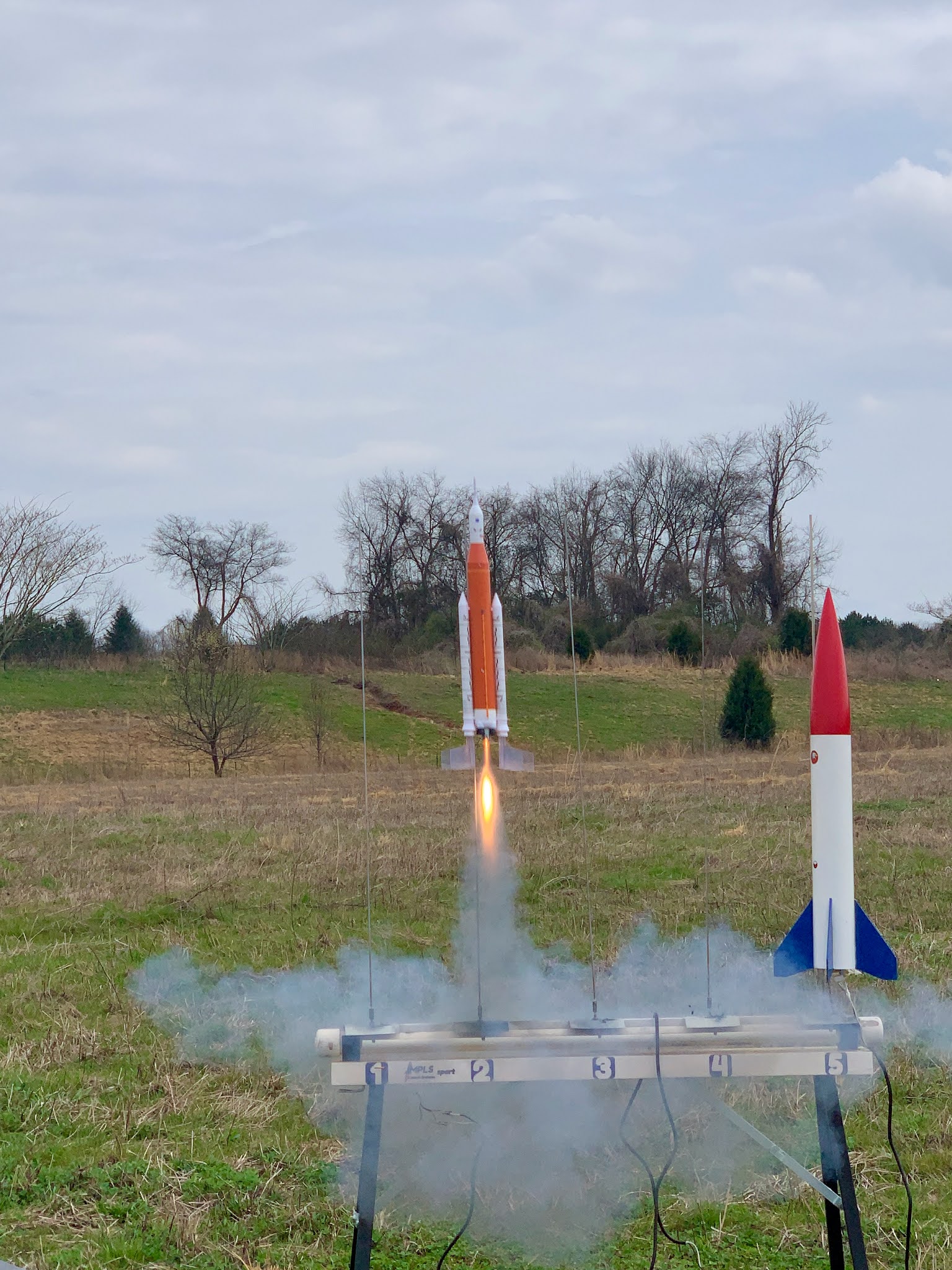
Launch #5 was another maiden voyage - that of my Estes SLS. The released version of the prototype I flew back in 2019 for the Apollo 50th anniversary, it is a RTF (Ready To Fly) model - no building, just stuff in a parachute and motor and go. However, I had decided that the first flight of this model would not use an Estes motor - I wanted some real fire and noise. So I popped in one of the new Aerotech "White Lightning" Q-Jets, a C18-4W. As I have mentioned, motors with the White Lightning propellant produce a brilliant white flame and a nice amount of noise. The C18 in my SLS did not disappoint. The rocket shot off the pad faster than a hound dog chasing a raccoon, producing a beautiful exhaust and a satisfactory sound as it streaked into the sky. The parachute deployed near apogee and the model safely touched down on the ground - I was very happy with the first flight of my SLS!

My SLS scoots on a White Lightning Q-Jet
(Click to enlarge).
Coming down under parachute (Click to enlarge).

Duane's 3" BMS School Rocket was next. He decided to live dangerously with this flight, loading one of the notoriously CATO-prone Estes E9's into the model. Both of us expected the rocket to blow into pieces on the pad, but the E9 did what Estes designed it to do. The model lumbered off the rod (low thrust to weight), arced over, and deployed the parachute. Duane had won his throw of the dice and I was left with some pretty standard launch sequence shots.

The School Rocket was followed by Duane's Estes Mega Mosquito, another one of those "I wish Estes had not discontinued this" kits. Textbook flight on a D12.

Duane's BMS School Rocket risks death riding an
 E9 (Click to enlarge).
Textbook flight of Duane's Mega Mosquito
(Click to enlarge).

#8 off the pad was my Estes "Shell Shocked". Introduced in 1998, the Shell Shocked was a rebranded Estes Omloid (first appeared in 1993). Both featured a huge, screw together egg capsule and plastic fin unit. The Shell Shocked was going to make my NARTREK Silver payload flight, but it would not carry an egg - a FlightSketch Mini altimeter would be the payload. I had cobbled together an altimeter "holder" out of a short length of BT-20 body tube and a CR-2070 centering ring - the fit was perfect! Using a push pin, I also punched three holes into the lower part of the egg capsule to allow proper air venting for the altimeter. The C6-3 powered flight went well - the FlightSketch recorded a peak altitude of 319 feet, in fairly good agreement with the 338 feet predicted in the kit instructions. NARTREK Silver payload flight completed - on to scale!

Estes Shell Shocked on a C6-3 (Click to enlarge).Shell Shocked under chute (Click to enlarge).

Flights 9 and 10 were a drag race of mine and Duane's Astrocams. This was intended to check out one of the features of the wireless controller, but I was also excited about the prospects of getting some nice launch shots and a cool video or two. Both models were powered by B6-4's, and my Astrocam left the pad a smidgen ahead of Duane's. The models almost crossed paths a few feet off the rod, and I was very, very, very eager to see the videos, especially from my camera, which should show Duane's rocket just beneath it. The Astrocam was plugged into my computer's USB port as soon as I got back to the apartment and I opened the video folder to look at what I expected to be a masterpiece. NOTHING was there. Crushed, I reviewed in my mind the moments just before the flight, and sadly realized what had gone wrong. I did indeed turn the camera on, but forgot to start it running by pressing the button again. After a little self-deprecating profanity, I called Duane to ask him to send me a copy of his video.  He informed me that there was no video, that he had also forgotten to activate the camera.

The Astrocams clear the pad (Click to enlarge).Almost colliding (Click to enlarge).

I felt a little better... At least I knew there was another dummy on the field that day <evil smirk>. Note to self - next time, bring the camera instructions and read them before flying the model. Might get a video if you do that.

Duane's last flight of the day was that of his red and white TARC rocket powered by an Aerotech F reload. I shy away from reloads - I don't have an organized mind, and the odds of me screwing something up in the assembly process is high. Being "Mr. Checklist", Duane doesn't have this problem, so he flies reloads all the time. However, about 50-100 feet off the pad, his rocket suddenly deployed the parachute and numerous pieces of the payload section fell to the ground - the nose cone hit just a few feet from my chair. Obviously something went wrong, but an inspection of the motor casing showed it to be in good shape and undamaged. Go figure...

Duane's TARC rocket clears the rail
(Click to enlarge).
The smoking rocket descends - Red circles mark
some falling stuff (Click to enlarge).

By this time, we had some company on the field. Chuck stopped by to watch and Doug and his family arrived with a few of their rockets to fly. Duane and I had flown everything we brought, so the pad was theirs - A Nova Payloader took to the sky soon after their arrival. It was followed by a D12-powered red and black Estes V-2, which drifted periliously close to the roof of the Blue Origin building - Have to watch altitude when the wind is out of the east at Pegasus. An Estes Star Hopper flew next, streamer deploying at apogee. The last flight of the launch was Doug's Estes Wizard, painted in the modern catalog decor. 

Doug's Nova Payloader goes up into the blue
(Click to enlarge).
Doug's V-2 lifts off (Click to enlarge).

Chuck watches the Star Hopper (Click to enlarge).The motor in Doug's Wizard ignites
(Click to enlarge).

But the best part of the day occurred after the launchings - Doug's daughter is a scout, and she had a generous supply of Girl Scout cookies in the back of their vehicle, just waiting for hungry old rocketeers to buy them. We handed over some cash, and I happily left the field with 5 boxes of my favorite flavors - I'm down to 1 box (Tagalongs) as I write this post.

Chuck was absolutely right when he said there were at most 2 servings in each box of Girl Scout cookies. They go very quickly.