Sunday, April 5, 2015

My first club launch of 2015 (part 2) - and now comes a little fire...

As I mentioned in my earlier post, I brought 6 rockets to yesterday's launch - my Aerotech Initiator, an Estes Majestic, an Estes Trajector, my Centuri RX-16 clone, an Estes Firebolt, and the Over Easy. Just after we arrived at the field, before any of my birds took flight, there was an issue - an errant chair had slipped in the gear unloading, knocking a fin off my RX-16. I was ticked; it is one thing for a rocket to show the scars of many flights, or to experience a hurtling death against the hard earth, but to suffer damage on the ground through poor handling, that just ain't right. My fault; I'm going to have to devise a better way to transport my mod rocs - throwing them in the back seat of a friend's vehicle is inviting an occasional mishap. Anyway, an application of 5 minute epoxy had the RX-16 ready to fly by late afternoon. It still looks bad, but I will attempt a cosmetic repair over the next few days.

And now, on to my flights...

My Initiator blasts skyward on an F20 White Lightning
motor (Click to enlarge).
The Trajector patiently awaits launch (Click to enlarge).
First up was my Aerotech Initiator. This is one of the oldest rockets in my fleet, dating from the very early 1990's and, though very battered, it is still a reliable flyer. Straight up on an F20-4W, with a gentle landing on the grass some distance from the pad. My thanks to Woody, who fetched it, cutting my walk in half.

Estes Trajector - My first flight was that of an old rocket; my second involved the newest, built in under an hour Friday night. The almost-ready-to-fly (ARF) Trajector flew well on an Estes black powder E16-6 motor, also experiencing a soft landing under its red parachute. One of the rocketeers on the field remarked that it spent more time in the air than I did in the building.

Estes Majestic - Also flying on an E16, the Majestic was majestic going up and serene coming down. Another member of the Estes mid power ARF line, it can be found in many Hobby Lobby stores, where the use of a 40% coupon makes this rocket an irresistible buy to those seeking a cheap mid power kit.

A full rack of rockets. My Majestic is the purple and silver rocket on the right (Click to enlarge).
3 flights, no problems. And then Murphy paid me a visit...

Estes Firebolt - It was supposed to follow the Over Easy, but ended up flying first because of ignitor issues. This rocket was loaded with an Estes E12-6, and did not even clear the rod before a spectacular motor CATO occurred, scattering fire and rocket pieces around the pad. The E12 I used came from a batch that Estes gave to the "Space Warriors" movie filmed at the Space and Rocket Center; Vince and I inherited several as thanks for helping with the rockets in the film. They must have been treated badly before we got them, because they have a 100% CATO rate so far (Vince had one blow up in his Hexagon saucer back in March). After I arrived back at the apartment, I marked those motors as bad - they will not be used, unless I wish to give them as a present to someone I don't like :)

Despite the appearance of catastrophe, the Fireboat suffered a minor zipper in the upper body when the payload section was blasted away. A little paper, CA, and silver mylar tape fixed it right up.

Image sequence showing the Firebolt's E12 motor CATO (Click image to enlarge).

Over Easy - This TARC rocket took 3 tries to get going; Bad ignitor on the first attempt, poor connection on the second. The D12-3 ignited on the third try, but once again there was a motor CATO, littering rocket parts on the field. The motor mount was blown clean through the Over Easy, with the upper centering ring still attached to the shock cord; the rip stop nylon parachute had several large burn holes. Amazingly, the body tube and payload section were unscathed. I constructed a new motor mount last night, and installed it into the rocket this morning. The Over Easy can fly again, though it will be using a different parachute.

The Over Easy erupts in flame halfway up the rod (Click to enlarge).
RX-16 clone - This rocket flew well on a D12-5 (no more CATOs, thank goodness!), but I could not get a connection to the Jolly Logic Altimeter 3 after my phone uploaded a firmware update. I could see the device in my Bluetooth setup, but the Altimeter 3 software would not connect. I may have to pair the altimeter to my phone again. Anyway, good flight with a safe landing. The RX-16 is now in the front of the repair line awaiting new fillets and cosmetic fixes.

Murphy is always present at these launches - in addition to my and Elliot's mishaps, we saw a high powered rocket come in ballistic, burying itself so deep that it took a shovel to dig out the nose cone. A rocket also accidentally launched when the high power pads were being loaded; a short was discovered in one of the relay boxes. No one was hurt, but there may have been some wet pants in the area afterward. These type things just emphasize the need to stay alert at a launch - never become complacent about safety.  Stand when rockets are taking to the air, and keep your eyes on the rocket; though it's very rare, they can come your way.

My first club launch of 2015 (Part 1)

Some of the folks at the launch watch a rocket descend to Earth (Click to enlarge).
Yesterday saw me and Duane making the long trek (about 2 hours) up to Manchester for the second HARA launch of 2015 - and our first. We arrived at about 11 AM, having left Huntsville around 8:30 and stopping for a "tasty" breakfast at McDonalds along the way. The field was a bit waterlogged from the thunderstorms of Friday night, but overall not too bad - there were patches of high ground that enabled one to recover rockets without sinking up to the ankles in mud. It turns out our late arrival was not really that late, as we got there in time to attend the traditional "flyers briefing" held before the start of every club launch. The Music City Missile Club (MC2) was working the range this month, enabling us HARA members to concentrate on flying. Next month, we have the range duty.

Flyers begin to gather for the pre-launch briefing (Click to enlarge).
Six rockets accompanied me to Manchester - my Aerotech Initiator (Aerotech F20 motor), an Estes Majestic (Estes E16 motor), an Estes Trajector (Estes E16 motor), my Centuri RX-16 clone (Estes D12 motor), an Estes Firebolt (Estes E12 motor), and my TARC rocket from a couple of years ago, the Over Easy (Estes D12 motor). I would fly nothing weaker than a D motor this day; after all, the launch is held on the wide open expanse of the Manchester sod farm. However, more power = more walking to recover, especially in the 10 mph winds. Duane also brought several rockets - his Estes Death Star, the yellow and black winner of this year's Geezer TARC - the "Beast", an Estes Leviathan, his Estes Mega Mosquito, and a big green and white rocket which would not fly due to the stiff winds.

One of the nice things about club launches is that you get to see rockets built by other people. Many of these are pretty awesome, like the Harley Max that showed up at the field yesterday. It was an Estes Mega Red Max, with a very nice paint job sporting Harley Davidson decals from Excelsior Rocketry. It flew a few times, including one on an H motor that garnered its owner a level 1 certification. A very excellent way to start on the High Power Rocketry path!

The "Harley Max" (Click to enlarge).

The Harley Max heads into the Blue on a G motor (Click to enlarge).
There is too much going on at club launches for me to keep track, especially given that I spend a fair mount of time prepping and recovering rockets. However, I did try to find the time to witness a few of the launches by fellow club members. Woody Bevill - who brought his Mom along for this launch - seemed to want to lose a scratch built mid power rocket; however, it kept coming back, though the "alien passenger" it carried aloft on its first flight was last seen heading into the next county, its little parachute dwindling into the distance. Keith Nyman and his daughter had a good day - his Mega Red Max powered by G motors impressed, and Brenna's Leviathan caught some air on an F motor. Not so for Elliot Laramie, who had a mixed day - after turning in several good flights (including a successful launch of a Quest Quad Runner with a cluster of 4 B6-4's), his "stretched" Colonial Viper did a major arc straight for the pond; I guess it thought it could also function as a canoe. The most heartbreaking event of the day was watching his beautiful Aerotech Astrobee D come in ballistic due to an ejection charge malfunction; not even the soft ground could prevent the rocket from turning into confetti. I would have gone into the trees and cried after that one, but Elliot is a true naval aviator; he simply shrugged his shoulders and said he would build another. There are no wimps in the Navy.

Brenna's yellow and blue Leviathan leaves the pad
(Click to enlarge).
Keith Nyman's Mega Red Max getting on up there
(Click to enlarge).

Elliot's Astrobee-D blasts off on its final flight
(Click to enlarge).
Keith Nyman's 2 stage CC Express heads up the rod,
powered by a C11 in the booster (Click to enlarge).
Duane's Mega Mosquito arcs into the wind on an E
(Click to enlarge).
The 4 B6-4's powering Elliot's Quad Runner leave a trail
of smoke (Click to enlarge).

Duane had a good day - His Leviathan put in a good flight on a Aerotech F, the Mega Mosquito got off the pad without experiencing a CATO, and the Beast once again showed why it was this year's Geezer TARC champion. However, it was the Death Star that garnered the most attention, with the big styrofoam ball perched atop a skinny tube. The first flight on a C6-3 was classic - the model arced into the wind and deployed the chute at a decent altitude. At ejection, the styrofoam ball "exploded" into four pieces, each one descending on a streamer - a real crowd pleaser. The second flight used an Aerotech D10-5 and had Duane's camera taped to the body tube to catch a video of the ball separating into pieces. This flight was not so good - the trajectory was much flatter, and ejection occurred very close to the ground. I am eager to see the video, as it must show the Death Star "exploding" as the rocket is diving into the ground.

Animated sequence showing the first flight of Duane's Death Star
(Click to enlarge).
Not all flying Saturday was for fun - there was also some seriousness. I counted 4 successful level 1 certification flights while I was there, and another HARA member, Ian, certified level 2. There were also some college SLI teams present - Alabama A&M launched their space-themed rocket on a K, only to have the main deploy at apogee. Fortunately, they were able to recover the rocket, though it did take some searching. Mississippi State put up a two stage rocket (M motor to J in the upper stage) on the far pad. It looked like the second stage did not fire, though all pieces landed safely. Auburn and Georgia Tech were in the final throes of prepping their rockets when Duane and I left the field at 4:30; I do not know the outcome of those flights.

A successful level 1 certification flight at Saturday's launch.

Monday, March 30, 2015

Fin

Yesterday saw the last of the TARC flights - all scores were due into TARC headquarters by close of business today. The Falcon Rocketeers were the only team on the field (Butler was unable to make it due to kids' schedules) and they brought with them the rebuilt War Eagle, now appropriately renamed Phoenix (it did arise from ashes, after all). They made a total of five flights - 3 practice and 2 qualification - but Phoenix was essentially a new rocket, resulting in some pretty high scores. There was no time (and too few motors remaining) to dial in the altitude. The Falcon Rocketeers deserve applause for finishing out the year, especially given the bad luck that they struggled to overcome. As they left the field, there was talk of getting started on next year's TARC as soon as the challenge is announced in May - a great attitude!

March 29 TARC scores. Green indicates qualification flight (Click to enlarge).
Nate showed up to provide me and Duane some support, bringing with him a few rockets that needed flying. I had several of my own, and we alternated putting birds into the air. My Semroc Golden Scout was up first, going surprisingly high on an A8-3. It behaved as it should, the ejection charge shifting the motor backwards so that the center of gravity was behind the center of pressure, causing the rocket to tumble to Earth. Sounds iffy, but tumble recovery was used in a fair number of the rockets produced in the 60's and 70's. Nate followed with his Estes Snitch saucer on a B4-4, and then I put up my Semroc Batroc on an A8-3. Batman would have been pleased to see the plastic parachute deploy, landing the rocket safely on the grass. It is currently sitting in a place of honor in my Batcave.

My Scout takes off powered by an A8-3 (Click to enlarge).The Batroc shoots up from the Bat Pad (Click to enlarge).
The Estes Hi Jinks took to the air next on a C6-5. The parachute did not deploy, but the nose cone did pop off, causing the rocket to land safely on the ground with little damage. This day would see no lawn darts, and I have to hand it to Nate for using C motors in most of his rockets. It was a bit breezy, and some drifted a decent distance from the pad. I then loaded up my Dr. Zooch Discoverer Thor, which flew on a B6-4. The good Doctor makes a point of ridiculing anyone who would wuss out and fly this thing on an A, and I certainly was not about to fall into that category. The Thor put in a text book flight, as did Nate's RTF Patriot, which grabbed some decent air on a C6-5.

Ignition! The Discoverer Thor gets started on its journey
(Click to enlarge).
Nate's RTF Patriot blasts off on a C6-5 (Click to enlarge).

Nate's Mean Machine has suffered a few mishaps, loosing a little bit of its length each time; it is now known as the "Lean Machine." Yesterday, the Lean Machine flew to a great height on an E9-4, and it is perhaps fortunate that the parachute failed to completely exit the body tube, as the rocket drifted a bit even just falling to the ground. No damage, so the Lean Machine did not loose any weight this flight. I have to admit that I am a little disappointed that there wasn't a spectacular E9 cato - Nate's luck is improving.

The last modroc flight of the day was that of my two stage Estes Scorpion clone, which was loaded with a B6-0 in the booster and a B6-6 in the sustainer. I figured the longer delay in the upper stage would minimize the drift of the rocket by putting it closer to the ground when the parachute deployed. This was a rare bit of good reasoning on my part, because that sucker flew nearly out of sight. I can't imagine what altitude it would reach on C6-0/C6-7 combo; maybe I will try it some club launch at the big Manchester sod farm. I should be able to recover the rocket there, assuming I am able to track it.

The purple "Lean Machine" on an E9-4 (Click to enlarge).My Scorpion heads for the wild blue yonder
(Click to enlarge).
And now, to bring the 2015 TARC season to a close, here's an animated sequence of the Falcon Rocketeer's Phoenix ascending into the Sun:


Saturday, March 28, 2015

Saturday's other flights

In the previous post, I mentioned that there were a total of 59 flights Saturday. Of these, 24 were TARC related; the others were miscellaneous rockets launched by the kids and adults present. Here is a listing of some of these flights, accompanied by a few pics. I don't have notes for all, as I occasionally had to watch a TARC flight, which took my attention away from the LPR pad.

The Satellite Interceptor just before malfunction
(Click to enlarge).
Nate snaps a pic of his Nike Smoke lifting off
(Click to enlarge).
Estes Satellite Interceptor (C6-5) - I swear this rocket of Nate's is jinxed. Once again, the motor CATO'd soon after leaving the pad. Fortunately, the damage was minor - the lower fin broke cleanly from the body. Very repairable.

Estes Hi Jinks (C6-5) - This RTF (Ready To Fly) rocket suffered a broken shock cord, but both pieces were recovered.

Quest Nike Smoke (C6-5) - This rocket made two flights, the first without mishap. On the second flight, the nose cone split in half on ground impact. Also repairable.

My Mark II clone starts its journey (Click to enlarge).A Liberty team member launches the Shuttle Express
(Click to enlarge).
Estes Mark II clone (A3-4T) - Even on a mini-motor, this rocket grabbed some altitude! I was impressed.

Estes Shuttle Express (B6-4) - This rocket also flew twice with no issues. However, the gliders were in sore need of trimming, as they nosed straight into the ground.

Estes RTF Patriot (C6-5) - No problem flight, with a landing close to the pad.

My Loadlifter 1-A on an A8-3 (Click to enlarge).Nate's towerless Mercury Redstone (Click to enlarge).
Loadlifter 1-A (A8-3) - Built from Estes Rocket Plan #19 and sporting a NASA logo, this rocket turned in a nice flight on the A motor. However, one of the fins was gashed upon landing, so some repair required.

EAC Viper (A3-4T) - Another of the "old reliables" of my fleet. Straight up, with a soft recovery on the grass.

Estes Mercury Redstone (C6-5) - This rocket belonging to Nate really did need its missing escape tower, as the 5 second delay of the C motor brought it perilously close to the ground before the chute deployed. Landing was a little hard, but no damage. I think he'll use a C6-3 next time :)

Vince's Hexagon lifts off on an E12 motor (Click to enlarge).The E12 erupts into fireballs (Click to enlarge).

Rocketarium Hexagon (E12-0) - Our NAR advisor, Vince, jumped into the action with a flight of his Hexagon on a Estes E12. For once, Nate was not the "CATO master of the day"; that honor went to Vince when the E12 spectacularly CATO'd just as the rocket let the rod. Surprisingly, there was no damage to the rocket.

Vince's Spider does its thing on a C6-0 (Click to enlarge).Nate's Snitch produces a little smoke (Click to enlarge).
Spider (C6-0) - A George Gassaway design, this rocket is built from a plastic Halloween candy bowl. It flies surprisingly well.

Estes Snitch (B6-0) - Not to be left out of the saucer action, Nate flew his Snitch on a B motor. Very short walk for its recovery :)

My Centuri Quasar clone makes another voyage on a
C6-5 (Click to enlarge).
A very nice scratch build rides a pillar of fire into the sky
(Click to enlarge).
Centuri Quasar clone (C6-5) - A mainstay of my fleet, this classic design rocket looked and performed well.

Estes Phoenix semi-scale (D12-3) - Big rocket, low and slow flight.

Scratch build (E18) - Launched by a newcomer to our club, this nice orange and black rocket roared into the sky on an Aerotech E18.

NCR Eliminator  (F15) - Vince brought out this old North Coast Rocketry bird (late 1980's), and launched it on an Estes F15. No CATO, and a pretty decent flight. I caught a quick video with my phone:


Estes Starchaser Thunderstar (2xB6-4) - One of my old X Prize kits, only one of the B motors lit when the launch button was pressed. Fortunately, the B had enough power to get the rocket high enough to safely deploy the parachute. One should really be careful when inserting ignitors in clusters...

Centuri Taurus clone (C6-5) - Another classic from my fleet; it turned in a nice straight flight on the C motor, and had a nice soft landing.

My Starchaser Thunderstar begins arcing to the right under
the thrust of only one motor (Click to enlarge).
My Taurus clone lifts off on a C6-5 (Click to enlarge)
Estes L.G.M. RTF with BT-55 booster (C11-0/B6-4) - This was my last flight of the day, in which I would once again try to capture video from the camera taped to the side. The rocket gods did smile on this flight, as I was able to catch several good frames when the rocket staged.

L.G.M. staging as captured by the onboard camera (Click to enlarge).
Here is the complete flight video:


This was the last modroc flight of the day; only TARC flights followed.

And now I am finally caught up with launch reports :)

Approaching the finish line

We normally have a "TARC regional" in March to gather the teams for practice or qualification flights. Not only does this give teams who do not have access to a good field a chance to get in some flying, it also enables the kids to check out how other groups are meeting the year's TARC challenge. We "crown" a local winner (sometimes there are even trophies, if we can find a sponsor), and a lot of fun is had by all. Unfortunately, this year was rained out...

However, the gathering at the Research Park field last Saturday was as big as any regional. Liberty Middle's Team Orion was there, along with some teams we don't see very often - Tanner, Russellville, and Huntsville Middle. Vince, our local NAR representative, also found the time to come out and join me, Woody, and Nate (Duane was on vacation with his family in the Redneck Riviera). As you would expect, there were a lot of TARC flights - practice and qualification. There were also quite a few non-TARC rockets launched - 59 flights in about 4 hours, making it roughly the equivalent of one of our club launches at Manchester. It was a busy day!

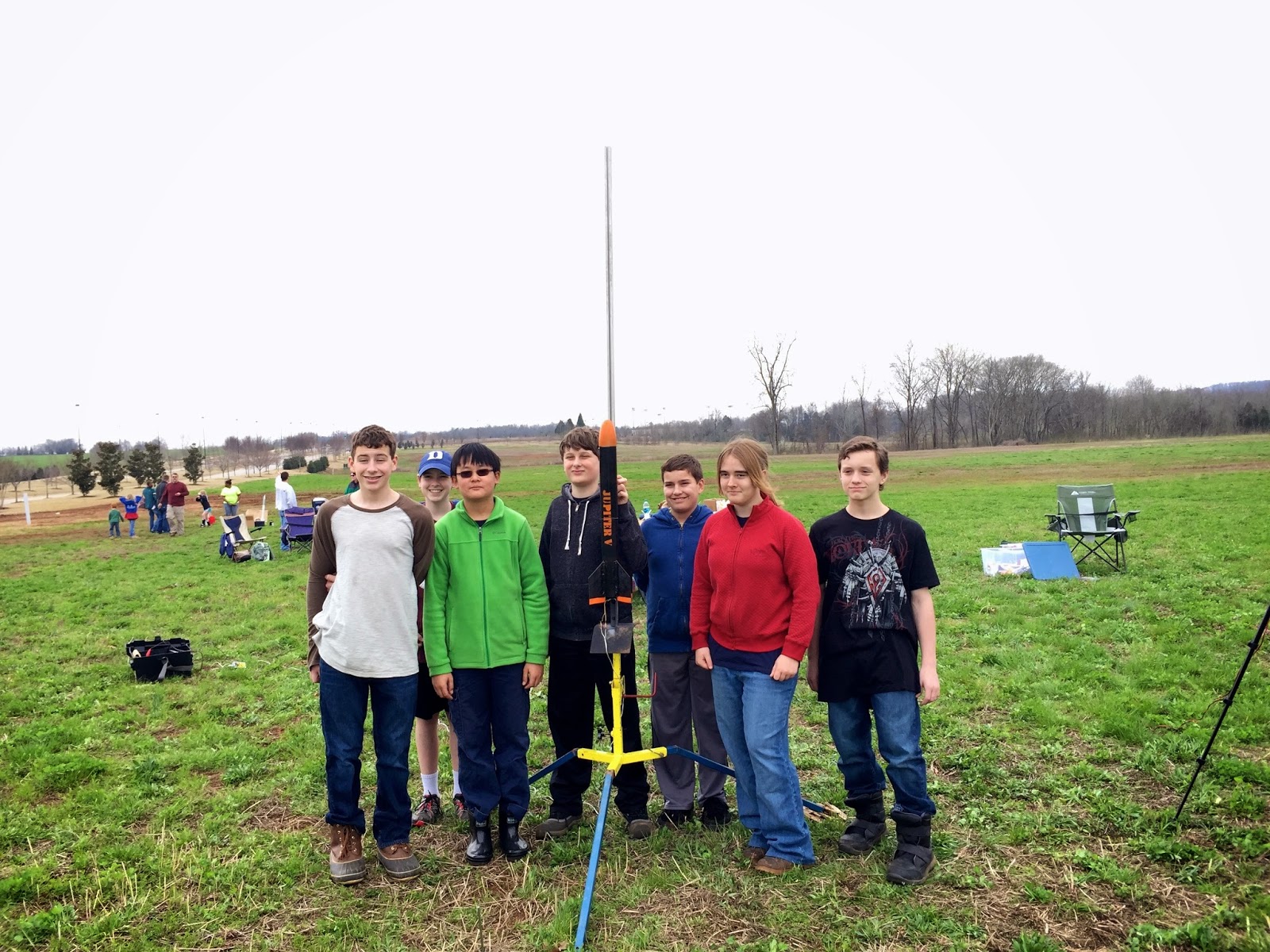
Liberty Middle's Team Orion poses with the Jupiter V (Click to enlarge).
Liberty Middle's Team Orion put in one practice flight with their Pluto rocket, then opted to switch back to the orange and black Jupiter V. In all, they made 9 practice flights and their last 2 qualification flights (69.7 and 28.4 scores), the most of any team present. Even though their scores are probably not good enough to get them into Nationals, I look forward to seeing them in TARC next year. They are a very good team!

Huntsville Middle put in a practice, but their sustainer came in ballistic. The rocket was damaged, putting them out of action for the day. Hopefully, they can rebuild and get their qualification flights done this weekend.

Tanner's rocket takes to the air on a qualification flight
(Click to enlarge).
The "Golden Rat" leaves the pad on a practice flight
(click to enlarge).

The big surprises of the day were the Tanner and Russellville teams, who originate in schools a decent way from Huntsville. We usually don't see them until qualification time, and I must say that this year they impressed in a big way. In the past, Tanner has had trouble making 3 qualification flights; this year, they produced three decent scores (31.0, 28.4, and a 41) using a beautiful white rocket with black trim. It was one of the best-looking TARC birds I have seen this year - I loved the classic lines! Tanner's scores were not bad; the team may have an outside shot at going to the Nationals.
The Russellville team made a couple of practice flights with their rocket - a nekkid bird they called the "Golden Rat." It was a rat in name only - after the practice rounds, the rocket turned in 2 fabulous qualification flights with 8 and 12 scores. These remain the best qual flights in Huntsville so far this year. Even though their 3rd qualification score was a more run-of-the-mill 34.4, Russellville's first two flights were so good that I feel confident that they are heading to Nationals in May. A truly outstanding performance!

TARC flights made on March 21. Green indicates qualification flight (click to enlarge).
Four days later, Duane and I met Jurassic TARC and the Falcon Rocketeers back on the field for some late Wednesday afternoon flying. Unlike Saturday, the day was sunny, but the winds were a bit stronger. Jurassic TARC made two practice flights, then launched their final qualification flight close to sunset. Rocket #2 flew higher than expected, resulting in 42.56 score. Not bad, but I do not think they will make the cut for finals. I thought the Jurassic TARC team did very well; unlike some others, they functioned as a team and made very few dumb mistakes. If these kids return next year, I think they will be a force to be reckoned with.

Rocket #2 makes its last qual flight of 2015 (Click to
enlarge).
Roll Tide's last beauty shot before being crunched
(Click to enlarge).

The Falcon Rocketeers launched Roll Tide on what was to be its final flight.  Up the rocket went, and it came down almost as fast - no ejection charge and no parachutes. Once again the sound of impact reverberated across the field, and Roll Tide crumpled under the tremendous force of collision. It will fly no more. With War Eagle burned and Roll Tide flattened, the Falcon Rocketeers were done for the day; last I heard they were hard at work trying to rebuild War Eagle by replacing most of the body tube.

Roll Tide after its ill-fated flight (Click to enlarge).

TARC flights made on the evening of March 25. Green indicates qualification attempt (Click to enlarge).
Just this weekend left for TARC flights - I expect a few more on Sunday. Then I can collapse...

Tanner's TARC rocket lifts off on a Smokey Sam composite motor.

Jurassic TARC's Rocket #2 blasts off in a sunset launch.