Wednesday evening once again saw me on the Research Park field. Three TARC teams were present - Butler High School, Pope John Paul II's Jurassic TARC, and the Falcon Rocketeers. Butler was conducting their last practice as Duane and I pulled up; Woody's email indicates they had a couple of pretty good scores. But that has been the curse of this year - good practice flights, bad qualification attempts. Sadly, Wednesday continued this pattern.
Jurassic TARC prepares the Gray Ghost for launch as Duane looks on
(Click to enlarge).
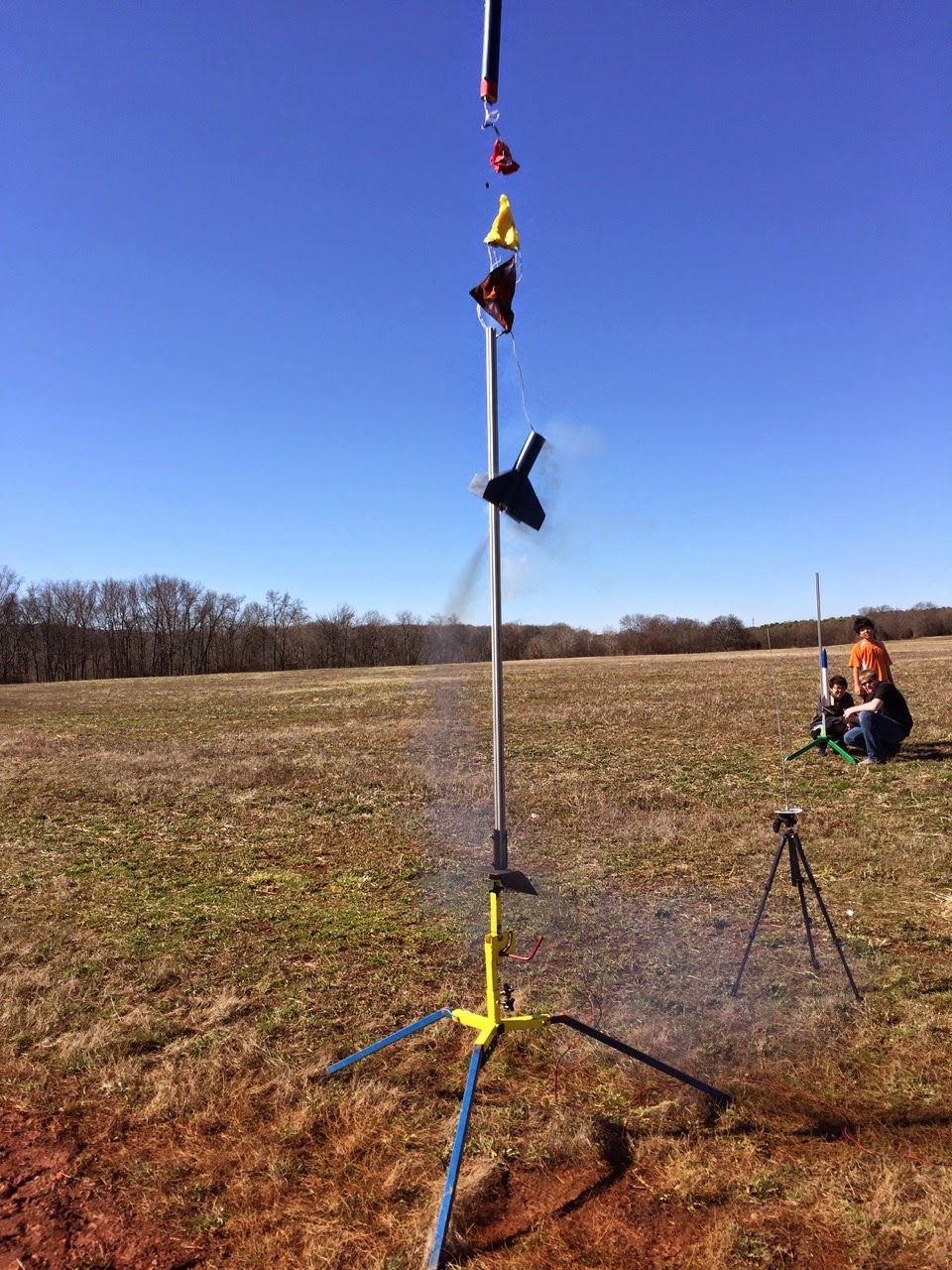
Jurassic TARC got the ball rolling with a practice flight using the Gray Ghost, which turned in an excellent score of 19. They then opted to go for two qualification flights, both of which resulted in not-so-good scores. The first qual flight was very low and suffered a parachute malfunction on the sustainer (but it came in slow enough to be safe). The second had a perfect time, but was over 90 feet shy of the altitude mark.
The Falcon Rocketeers were also plagued by bad luck. Their first practice flight saw War Eagle come apart on the pad and catch fire; the flames were stomped out as soon as the rocket hit ground. An email sent out on Thursday by the team captain confirmed that the rocket was not repairable - a fiery end for a noble bird. Falcon then launched Roll Tide on another practice flight - it soared to a fabulous 798 feet, but neither of the parachutes deployed. Fortunately, the rocket managed to survive the hard landing relatively intact - it will fly again.
The Gray Ghost lifts off on a qualification flight
(Click to enlarge).
War Eagle comes apart leaving the rail (Click to enlarge).
Not a good evening for our local teams... The next launch is scheduled for tomorrow - will the weekend see the lifting of the curse?
March 18 scores - green indicates a qualification flight (Click to enlarge).
This evening, Duane and I travelled to a field northeast of Huntsville to qualify flights for the Buckhorn TARC team. This is the first time in TARC for these kids, and I must say I was very impressed - their rockets were efficient, capable of meeting the altitude mark on an E20, and sported nice paint jobs in the school colors. The team had great equipment, were well organized, and had conducted several practice flights during the past two weekends. They could teach a thing or two to some of the Huntsville teams, even the experienced ones.
The Buckhorn team loads their rocket ("Bucky") on the pad (Click to enlarge).
Duane and I showed up at about 5:30 pm to find the team all set up and ready to go. It was a bit breezy, but if one waited for a couple of minutes, the wind would slack off long enough to permit a good flight. Wind was not the problem this evening - the "Curse of TARC" still plagues our local teams, insuring that practice flights give good scores but qualification flights end badly. So it was with Buckhorn this evening. Their first flight ended with a disqualification when the parachute broke away from the payload section, which hit the ground hard enough to break the egg. The second qualification flight also was disqualified when the payload section parachute did not fully open, resulting in another omelette. The altitudes on these flights were ok - 850 and 817 feet - but the stupid payload section parachute would not cooperate. However, the third time was the charm - Bucky shot skyward to 843 feet and was down in 53.8 seconds, for a 66 score. Not bad at all - I was very happy that they had one good flight to send in to TARC Headquarters.
Buckhorn qualification flights (Click to enlarge).
This team had several 7th graders, and I hope they participate in TARC next year - They are very, very good. If it weren't for that stupid TARC curse...
Bucky awaits launch (Click to enlarge).
A very nice Estes QCC Explorer built by someone at
Buckhorn (Click to enlarge).
went to the field to witness more TARC flights. This evening, we had two teams out there - Pope John Paul II's Jurassic TARC team, with their Gray Ghost rocket, and the Falcon Rocketeers with War Eagle and Roll Tide. One flight of the Gray Ghost was made before Duane and I arrived at 5 PM; 4 more would occur before we packed it in around 6:30.
The TARC teams of the day - Jurassic TARC is at left with the Falcon
Rocketeers on the right (Click to enlarge).
Jurassic TARC is pretty close to getting it done, turning in decent scores on both of their practice flights. The Falcon Rocketeers are still tuning their War Eagle rocket, which flew too high in today's still air. Its last flight was also calamitous - the parachute on the sustainer failed to deploy, and it dove straight for the ground. You know things are going to be bad where you hear the sickening thump of impact across the field... Sure enough, War Eagle looked a bit like an accordion after that flight. Major repair time, I think.
Summary of today's 4 practice flights (Click to enlarge).
The westering Sun saw the session end with no qualification flights; these after school sessions don't leave much time for practice, even with Daylight Savings Time in effect. Judging from the chatter, Falcon is going to try for more flights on Wednesday afternoon - assuming it's not raining.
The Gray Ghost lifts off on its last flight of the day
(Click to enlarge).
War Eagle soars into the sky yet again (Click to enlarge).
A nice thing about using a local field is that interested folks sometimes come out to watch you fly. Today, we had a local dad who is getting back into rocketry with his sons show up to watch the TARC flights. Duane and I tried to recruit him into joining HARA, or at least to come out and fly with us sometime. He is excited about rockets, and has already got a good start on a decent rocket fleet. Also said he reads this blog, which I found gratifying. It's good to know someone reads my ramblings!
Back to the launch... I had brought a C6-3 for Duane's Death Star, which was going to be the star in one of my videos - naturally, he forgot the rocket. However, I did bring along my Little Beth X-2 for my one and only flight of the day. This time, I set my normal wimp tendencies aside and almost went for broke with 2 B4-2's and a C6-0 in the booster, and a B6-4 in the sustainer (you knew there had to be a B6-4 in there somewhere, didn't ya?). After taping my keychain camera to the rocket, I placed it on the pad and started snapping off pics as Duane did the count; our visitor began to capture video on his phone. All three booster motors roared to life and Little Beth shot off the pad like a bat out of Hades. Booster separation and second stage ignition occurred without a hitch, and she kept going up, up, up. As I watched, I was thinking that there was NO WAY I was going to ever put a C6-7 in that upper stage, as we were barely able to keep the rocket in sight. The green parachute deployed, and the rocket slowly began to drift towards the ground. I was a little worried about the tree line, but the rocket gods did smile upon me and allowed my white and black beauty an honorable landing upon the field.
Little Beth blasts off on 3 booster motors (Click to enlarge).
After I got back to the apartment, I transferred the video to my computer and discovered, to my chagrin, that a video curse still plagues me. I did get video of the flight, but the camera was pointed at an angle towards the rocket body rather than straight down - so there is a lot of white rocket in the frames. Nevertheless, here's the flight vid - not my best work, to be sure:
And here are some select frames:
Ignition (Click to enlarge)!
The road below... (Click to enlarge)
2nd stage ignition (Click to enlarge).
Under parachute (Click to enlarge).
Hopefully more flights later in the week - stay tuned!
This afternoon found me once again in the field with a couple of local TARC teams for practice and qualification flights. My usual comrade, Duane, was working and stopped by for a bit around lunch; Woody was the NAR member who certified today's scores. When Nate and I arrived at the field around 12:30, Pope John Paul II's Team 1 was already there, practicing with their "Nekkid Rocket 1" (I understand there is also a Nekkid Rocket 2, but that was not flown today). Liberty's Team Orion (7th graders) soon joined them, and the flying began in earnest.
Pope John Paul II's Team 1 readies Nekkid Rocket 1
(Click to enlarge).
Liberty Team Orion's Jupiter V (Click to enlarge).
There were a total of 10 TARC flights between 12:30 and 3:30 PM today. Of these, 4 were valid qualification flights - 3 by Pope John Paul II's Team 1 (scores of 111, 50.9, and 36.4) and 1 (score of 49) by Liberty's Team Orion flying their Jupiter V rocket. A week ago, they were flying the Jupiter IV; the Jupiter V was obviously an improvement, as it turned in much better scores than its predecessor. John Paul's Team 1 is finished, and I was struck by the similarity of the scores to those of Liberty Team Centron. I wonder if this pattern will hold for the rest of Huntsville TARC teams?
March 15 TARC flights - green denotes a valid qualification and yellow indicates
a problem allowing a reflight (Click to enlarge).
Two of the flights were oopses - the timers (both of them) had troubles with their stopwatches on one flight of Nekkid Rocket 1, and the payload section of Jupiter V caught a thermal and drifted into the top branches of a tall tree - not recoverable. So they get to rebuild the payload section of Jupiter V. I hope they have an altimeter to replace the one hanging 60 feet above the ground... Very unfortunate.
The Sun was shining, the sky was a beautiful blue, and the temperature was comfortable; naturally the day would see rockets other than TARC birds taking to the air. Nate had brought 6 birds to fly - a Mercury Redstone, Hi Jinks, Patriot semi-scale, Shuttle Express, and Snitch, all by Estes. His other rocket was a Quest Nike Smoke. I had declared today Centuri Day, and brought four of my finest Centuri clones - the Orion, Stellar Hercules, Long Tom, and Egg Crate. The Orion flew on a C6-3, the Hercules on a B6-4, the 2 stage Long Tom on a C6-0/B6-4 combination, and the Egg Crate on two B6-4's.
Orion on the pad (Click to enlarge).
My Orion heads up into the blue sky (Click to enlarge).
Nate's Mercury Redstone clears the pad (Click to enlarge).
Nate's Nike Smoke invades Pope John Paul II's launch
space (Click to enlarge).
All of the flights went well, except for that of the Long Tom and Egg Crate. The flight of the Long Tom appeared to go well, except that the booster seemed to hang on a little longer than normal, and when it separated, it went into a smooth glide, landing gently on the grass. The only Centuri rocket with a gliding booster is the Black Widow, and I knew that of the Long Tom was supposed to tumble back to Earth. Examination of the returned rocket explained everything - apparently the booster motor tube coupler fit too tightly on the sustainer motor tube, and the ignition of the upper stage literally burned through the lower motor tube, leaving the coupler still stuck at the base of the upper stage. This internal damage was quickly repaired once I got back home, and the Long Tom is now ready for another flight.
Liberty Team Orion watches the Long Tom blast off
(Click to enlarge).
Long Tom booster coupler after I removed it from the
bottom of the second stage (Click to enlarge).
The Egg Crate's maiden voyage on the two B6's was marred only by the fact that I apparently forgot to turn on the keychain camera taped to the payload section. So no video - duh! I had considered taping it to the Long Tom - which would have yielded a more impressive video - but opted to play it safe after last weekend's Cobra mishap. Clusters are somewhat finicky, but multistage rockets can have much more spectacular crashes; I had visions of camera parts scattered next to an upper stage buried deep into the ground.
Egg Crate on the pad (Click to enlarge).
The 2 B motors get the rocket up fast (Click to enlarge)!
Below are a couple more pics from today - tomorrow will see more flights after work. I think I shall live dangerously and fly my clustered, 2 stage Little Beth X-2.
The Stellar Hercules poses before launch (Click to enlarge).
Jupiter V starts a qual flight (Click to enlarge).
Last weekend was very busy, with TARC practice going on at the field on both Saturday and Sunday. 11 flights were made on each day, with 1 qualification attempt by Liberty Team Centron (the 8th graders) on Saturday and 3 attempts (2 by Team Centron and 1 by the Falcon Rocketeers) on Sunday. Team Centron and their rocket, Orange Crush, have completed all three of their qualification flights, posting scores of 106, 60, and 20. The Falcon Rocketeers' only attempt on Sunday ended in a disqualification (DQ) when the booster of their "Roll Tide" rocket came in ballistic. Here's a summary of Sunday's TARC practice:
March 8's TARC flights. Green indicates a qualification attempt (Click to enlarge).
The Falcon Rocketeers' War Eagle lifts off
(Click to enlarge).
Nate attends to a finicky igniter (Click to enlarge).
Roll Tide's exhaust hits the blast deflector
(Click to enlarge).
Liberty's Orange Crush leaves the pad on a qual flight
(Click to enlarge).
Of course, TARC rockets were not the only birds taking to the air; Duane launched his Estes Death Star and Cherokee D on C motors, and there was a TARC parent who put up an Estes Vector Force (C6-5), an Estes Crossfire (also on a C6 motor), and a mini-engine powered Estes Sky Dart. He showed more guts than me in putting a C motor into the Crossfire; I thought it would be a goner, but, to my surprise, the rocket landed within the field.
Liftoff of an Estes Vector Force on a C6-5
(Click to enlarge).
Duane's Cherokee-D heads skyward (Click to enlarge).
I launched my Estes Chuter 2 on a B6-4, my Estes Cobra clone on a cluster of 3 B6-4's, a Quest saucer on a C6-0, and the Estes SCRV (Space Camp Research Vehicle) on a B6-4 - it was a day for B motors! The SCRV carried my Altus Metrum Micropeak altimeter, which recorded a peak altitude of 279 feet; however, the data was very noisy due to the altimeter moving around within the payload section. I have to insure that I have proper centering rings to produce a snug fit for the BT-20 holder, which was kinda hard to do for the obsolete HBT-1090 tubes used in the SCRV.
Estes Chuter-2 on a B6-4 (Click to enlarge).
Quest saucer doing its UFO thing (Click to enlarge).
I wish I could say the Cobra flight went well, but it didn't. Liftoff was perfect, with the Quest Q2G2 igniters firing all three motors, but the payload section separated at ejection. The sustainer came in ballistic, and the weight of those 3 empty motor casings drove it about 5 inches into the soft ground, resulting in a nice core sample of the Alabama earth. The damage is repairable, and the Cobra will fly once more when I have replaced the upper part of the sustainer.
My Estes Cobra clone clears the rod on 3 B motors
Click to enlarge).
The aftermath, showing damage to the sustainer
(Click to enlarge).
I had strapped one of my keychain cameras to the rocket, and fortunately it managed to survive the impact with just a little dirt on the case. Here's the vid from that camera - notice the "high speed effect" as the rocket does its dive into the ground.
Moment of ejection (Click to enlarge).
Insult to injury - the camera spots the payload section and parachute high
above the sustainer, which is plunging to the ground (Click to enlarge).
Grassy debris kicked up at impact (Click to enlarge).
There is supposed to be another TARC session at the field tomorrow... I wonder what I am going to fly?
Yesterday, the clouds lifted and the Sun started to melt the ice. Today, it warmed up into the low 50's under sunny blue skies - a perfect day for much-needed TARC practice. Duane and I journeyed to the nearby field around noon to meet up with three teams - Liberty Middle's Team Orion (7th graders) and Team Centrons (8th grade), and the Falcon Rocketeers. The field was not in the best shape - muddy, with lots of puddles from the ice melts. However, there was some higher, drier ground where we set up the launch pads. Duane had to go to work for a bit (to make up for Wednesday/Thursday's ice event), so he headed out soon after the pads were set up. This left Woody and I to provide the Falcon Rocketeers with any guidance they might need; Nate had the two Liberty teams well in hand.
The launch kicked off with Nate's yellow Satellite Interceptor, which emitted a nice orange fireball just after leaving the rod - the Estes motor had cato'ed, but fortunately there was little damage to the rocket. A Balsa Machining School Rocket was launched next to test the winds, which were light out of the southwest. The flight went well, landing about 50 yards from the pads. I followed with my Estes Citation Patriot clone on a B6-2 (yeah, I know, I'm a chicken for not using a C motor). Low flight to maybe 200 feet and a soft recovery on the grass.
My Citation Patriot clone takes to the air on a B6-2 (Click to enlarge).
Next up was a Woody Bevill scratch build (you can see it on the ground to the left of the tripod in the pic above), flying on a G79. Woody has not had much luck with this motor - 6 have failed (some fantastically) while powering his other vehicles. No one had brought a launch pad that could handle a 1/4" rod, so he simply jammed one into the wet ground, meaning that the rocket would literally launch from the "ground up." Not normally safe, but there was no chance of a fire given the soggy field. As expected, the G79 had issues - but no fireballs, no explosive rupturing of the casing. It simply had trouble getting going, as you can see from the video below. This turned out to be the rocket's last flight, as the nylon shock cord zippered the tube beyond repair at ejection. Woody took advantage of the turn of events to disassemble the rocket and show me his neat removable shock cord mount.
The TARC rockets took to the air after Woody's flight. There were 11 flights, with the best score of 15 achieved by Liberty Team Centron. Their rocket, the Orange Crush, was by far the best performer of the day, achieving altitudes of 791, 807, and 725 feet. Unfortunately, the last one was made during the one and only qualification attempt of the day. Being 75 feet shy of the 800 foot goal and a short duration of 38.15 seconds resulted in a 106 score, far worse than the 15 and 23 achieved on their practice flights. No worries, though - they still have two more qualification attempts.
Liberty's Orange Crush leaves the pad riding purple flame (Click to enlarge).
Liberty's Team Orion was consistently low in altitude with their two rockets, Pluto and Jupiter IV. These blue rockets just couldn't seem to grab enough air, even on F impulse. Jupiter IV flew highest, reaching 578 feet on an F20; its previous flight had a peak of only 407 feet, caused by yet another malfunctioning composite motor. That F motor "chuffed" on the pad for a few seconds before building up enough thrust to propel the rocket skyward. Poor Pluto couldn't best the bigger Jupiter - after a first flight to 561 feet, he came apart on the rail when the motor broke retention and shot clean through the body.
Team Orion's Jupiter IV finally clears the pad on a balky F motor (Click to enlarge).
Pluto comes apart on the rail as the Falcon Rocketeers look on (Click to enlarge).
The Falcon Rocketeers were not idle, putting in 4 flights with their "Roll Tide" and "War Eagle" rockets. The red and white Roll Tide had trouble reaching the goal posts; its highest altitude was 769 feet on an F24. The blue and white (?) War Eagle did a little better - its first flight peaked at 849 feet, whereas the second one was a bit low at 758 feet. Like Liberty Team Orion, they need to do a bit more work on their rockets.
Falcon Rocketeers' Roll Tide leaves a lot of smoke behind as it clears the rail (Click to enlarge).
The blue and white War Eagle streaks to 849 feet (Click to enlarge).
There were some scattered model rocket flights in between the TARC launches. Nate flew his Estes Snitch on an A8 to about 30 feet, and I launched my Estes Patriot semi-scale model on a C6-5. It got some nice altitude and landed about 50 yards away. I need to man up and fly more C's! My last launch was the Estes rocket used at Space Camp, the SCRV (Space Camp Research Vehicle) on a B6-4. It carried my Micropeak altimeter, but I stupidly left the thing on and the data got overwritten before I could download it into my computer. Got to remember that this altimeter has an on/off switch.
Nate's Snitch on an A8 (Click to enlarge).
Semi-scale Patriot blasts off on a C6-5 (Click to enlarge).
The SCRV's B6-4 motor ignites as the Liberty teams watch (Click to enlarge).
I just got an email from Duane - more TARC flights tomorrow. The push to get decent qualification scores before the end of the month deadline has begun... It looks like I'm gonna be busy the next couple of weeks!