Thursday, July 17, 2014

Tweaking the Mark 1

The more I thought about the Mark 1's design, the less happy I was about the fins. I like my rockets to be stable without needing weight up near the nose, and those 3 small fins kept coming to mind, kinda like that "Let it go" tune from Disney's Frozen (Disney is truly the evil Empire - stay away from their movies or you will have those medleys dancing though your head for days, morning until night). Even though OpenRocket said the rocket was stable - with the egg and altimeter - I kept having bad feelings about the margin. So I finally broke down and tweaked the design a bit by adding a fourth fin. This increased the stability to 2 calibers fully loaded, which brought some comfort to my tortured mind; I only wish getting that stupid song out of my brain was as easy.

While I was tweaking, I replaced the thick balsa coupler with a thin plywood bulkhead/cardboard tube coupler combo, thereby shedding some weight. The improved Mark 1 design shows 80 feet play room with just 2 D12 motors. If I watch the weight, I may be able to pull this off with just those motors rather than going for broke with the full 2xD12, 2xA10 cluster. That's good, because igniting 2 motors is easier than lighting 4. The big unknown here is how much weight the primer/paint will add.

The tweaked Mark 1 (click to enlarge). I is much happier!
I have started construction of both the Mark 1 and 2. Tubes and fins have been cut, motor mounts and shock cords installed. Tonight I shaped the Mark 1 fins - you can see them in the pic below along with the other parts (the Mark 2 fins are lying off to the left). I hope to have the assemblies completed and in finishing by the end of the weekend.

Mark 1 parts.
Off to watch "Catching Fire" now - maybe a little gratuitous violence can drive Elsa from my mind.


Sunday, July 13, 2014

The old guys take on TARC!

Work travel has been kicking my rear lately - Finland, Houston, and soon Washington. It has definitely put a damper on rocketry activities, but August should see a return to a more normal routine. I certainly hope so, because I have been challenged.

A couple of weeks ago, Duane challenged me, Nate, and Woody to a rocket contest. We are to build rockets capable of meeting this year's TARC goals and fly them for the first time at a launch in mid August; no practicing allowed. The dude with the best score wins the bragging and swaggering rights. In case you don't know or remember, here's a quick summary of the 2015 TARC challenge:

  • Fly 1 raw hen's egg (weight of 2.1 ounces) to 800 feet. Altitude is measured by a Perfectflite APRA or PNUT altimeter.
  • The rocket must be at least 25.6 inches in length and weigh less than 650 grams (22.9 ounces) fully loaded.
  • The payload section containing the egg and altimeter must separate from the sustainer. It must descend by parachute, whereas the sustainer can use any safe means of recovery.
  • The payload section must land the egg safely (no cracks) 46-48 seconds after first motion on the launch pad.
  • Rockets are restricted to less than 80 newton seconds total impulse (F class or less).

Not easy, but I think I can win this. As a matter of fact, I have already come up with 2 designs. Neither have names (yet) - right now, they are known as Mark 1 and Mark 2. The names will come as I build.

The Mark 1 is a BT-70 (2.17" diameter) based rocket powered by a cluster of 4 motors - 2 24 mm and 2 13 mm. Standing 30" tall, it features 3 smallish fins to minimize turning into the wind. Stability is good at just over 1 caliber when loaded with 2 D12's and 2 A10's. As you can see from the Open Rocket simulation below, I should be able to make the 800 foot target with just 2 D12-5 motors - IF the weight is as expected, the drag coefficient is right around 0.75, and the motor thrusts are nominal. Too many things need to be right, so that's why I have the 2 A10's. These little motors provide just enough thrust to buy me a margin of an extra hundred feet in altitude, which hopefully will compensate for higher drag and/or lower thrust.

Open Rocket simulation of the Mark 1 (click to enlarge).
Open Rocket depiction of the Mark 1 in flight (click to enlarge).
The Mark 2 is a more conventional (i.e., non cluster) design. It is a minimum diameter (1.8") bird powered by a single 24 mm composite motor, like an Aerotech E15 or E30. Open Rocket shows that I have over 200 feet of altitude margin, so I will probably have to add a little weight to this puppy if I choose to fly it. Yep, you heard right - I intend on building both of these rockets and will select the model that will fly against the others on the day we launch. Never hurts to have choices.

Open Rocket simulation of the Mark 2 (click to enlarge).
Open Rocket depiction of the Mark 2 in flight (click to enlarge).
The next few weekends are going to see a lot of rocket building.

Sunday, June 22, 2014

Southern Thunder - the final day

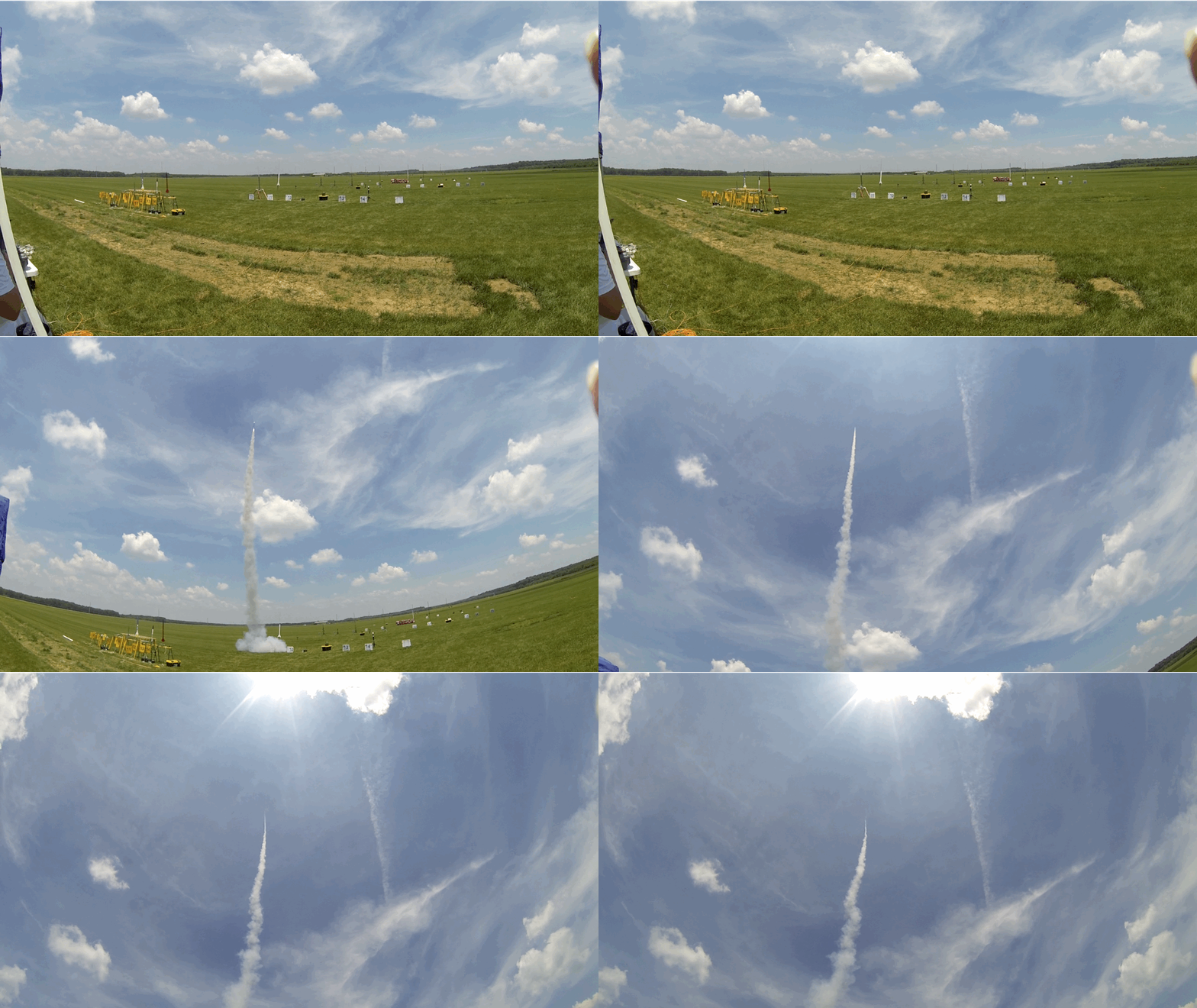
A rocket leaves the pad under G motor power at Southern Thunder 2014.

Slowed down version of the above (Click to enlarge).
Southern Thunder is over, and I am back home - bruised, sun burned, and more than a little tired, but pleased. To say that ST2014 was a good launch would be an understatement - HARA had 300 flight cards at the beginning of the launch yesterday, and they were all used, forcing us to record flights on scraps of paper this morning. Many rockets once again took to the skies in the sweltering, storm free summer day provided by Mother Nature. I flew 6 rockets:

  • Odd'l Rockets Birdie - very good altitude on an A10-3T. I love this flying badminton birdie - quick to prep (just insert motor) and it always lands close to the pad.
  • My trusty Centuri RX-16 clone - Rockets had been landing in the Christmas trees to the south, so I opted to fly it on clustered B6-4's (2). It had a Perfectflite altimeter on board, which showed a peak altitude of 258 feet. I will download the flight profile for analysis later this week.
  • Estes Constellation clone - Nice straight flight on a B6-4. I turned down several offers of tick passengers  for the clear plastic payload section from rocketeers infested with the vermin.
  • Estes Alpha (1960's decor) - Decent flight on an A8-3. Trying to use these motors as much as possible, as I have about eleventy billion of them.
  • Centuri Screaming Eagle clone - Beautiful flight on on a B6-4. Landed between the rows of Christmas trees.
  • Estes Mean Machine clone - Fishtailed a bit on the E9-6 motor. Nice altitude, but it landed near the top of a big tree to the Southwest. Recovery not possible, so this one is a loss - Its first flight was its last flight. On the plus side, Nate's Mean Machine flew superbly, and he recovered it near the Christmas trees. Here's the video of the launch:


More later this week - have much to unpack before I get to sleep.

Saturday, June 21, 2014

Southern Thunder Day 1...

did not start well. After eating breakfast at Cracker Barrel, Nate and I headed to the field and unloaded our stuff. I then moseyed over to help with the numbering on the model rocket pads, and, graceful creature that I am (NOT!), ended up tripping into a fairly deep mud hole caused by last night's rain. Down I went, taking the impact on my left wrist and getting my pants and shoes thoroughly covered in mud. I was able to change into new pants, but the left wrist hurts and is badly swollen - probably sprained.

While nursing my wrist, I also came to the realization that I had left my rocket parachutes back at home. Flying rockets would not be much fun if they came in ballistic and left nice little holes in the Tennessee sod, so I made a trek to the on site vendors' tents to see what they had. Chris Short had several nice nylon chutes suitable for model rockets, and, after a few minutes and an exchange of 43 dollars, I was back in business. This was the turning point of the day, which had pretty much sucked up till then.

View of the mod roc pads at Southern Thunder 2014. My KSR-420S model
is on the rightmost rod.
The first rockets left the pad around 9 AM, and it was non-stop from that point on. Many rockets (I would guess well over 200, probably close to 250-280) took to the air; I managed to put up four:
  • Balsa Machining Service Mini Bomarc - very stable on an A10-3T mini motor. The parachute was only 9" in diameter, but it drifted into the  Christmas trees on the south side of the field. Ever-reliable Nate managed to find and recover it.
  • A.S.P. Corporal scale model - straight and high flight on a D12-5.
  • Rocketarium scale model of the KSR-420 S sounding rocket - decent altitude on 3 A8-3 motors, landed just 50 yards away.
  • Estes Scamp clone - this flight used one of my many Quest A6-4 motors (I am not a big fan of these, but I need to reduce their numbers). It soared to over a couple hundred feet and landed near Vince's SUV in the spectator area.
Nate's trusty yellow Satellite Interceptor turned in a nice flight, but his Estes Ascender shredded a fin on the way up. His Mercury Redstone had a broken ignitor, which seemed to put the kibosh on another attempt. There were several successful high power certification flights, but the upper stage of the 2 stage M powered rocket built by the Mississippi State Space Cowboys had a motor casing failure which trashed the second stage - the booster landed safe and sound, whereas there was debris from the upper stage scattered in several places on the field. Many rockets drifted into the trees to the South and West, which made me feel very sorry for the owners, who would be no doubt covered in ticks even if they managed to recover their rockets. There was another crying moment when Elliot Laramie's beautiful Estes Interceptor-E came in ballistic, destroying itself against the turf. Interceptors take a long time to build; heck, even decaling them takes several hours, so this was a tragic turn of fate.

There was an amusing moment when the parachute of an upper stage of an Estes Mongoose managed to snag the tip of the Phoenix Missile Works' Alabama flag. No way could you do this intentionally!

A rocketeer attempts to retrieve the upper stage of an Estes Mongoose hung on the Alabama flag.
The hundred rocket launch was supposed to occur at 5 PM, but Mother Nature sent some severe storms our way at that time, which forced the launch to close down for the day. Nate and I got packed up just before the heavy rain hit, and we saw several "easy-up" tents being overturned and collapsed by the strong winds as we were leaving the field. There are going to be some unhappy folks when they return tomorrow.

And return I shall - I still have rockets to fly. Hopefully, I will be a little less of a klutz and not damage myself further.


Sunday, June 8, 2014

Little things...

First, a whine...

Today's rocketeer has an unparalleled selection of kits, motors, electronics and other accessories - we can fly higher, faster, and with more sophisticated payloads than in the past. However, despite the overall wide variety of motors, the available types of low power (13 and 18 mm) engines have diminished in number over the past three decades. I attribute this to two factors - the decline of contest rocketry, beginning in the late 70's and continuing to the present, and the rise of high power rocketry (HPR), which shifted motor development to higher impulse classes. As a result, those of us geezers who wish to clone three stagers such as the Estes Farside are forced to modify the 1st stage to 24 mm (D) power because of the loss of the high thrust B14 motors; our international contest teams have been compelled to use European motors because 13 mm B motors are no longer produced by U.S. companies. Even though the kit choices are greater, the low power rocketeer of today has to contend with a diminishing motor selection. This is likely to get worse in the future, unless some small company steps up to fill the niche. Given current government regulation, high startup cost, and the small market, I kinda doubt this will happen.

We need little motors too, ya know. Especially if you have to fly in a school yard, a back yard, or a soccer field. Not everyone has access to an hundred acre sod farm.

End whine.

I was looking over my built 13 mm rockets this weekend, and noticed that I had a few gaps in the Estes Mini-Brute line. First introduced in 1972 to take advantage of the new Estes 13 mm motors, the group featured nine rockets - the Mosquito, the Screamer, the Birdie, the Hornet, the Mini Bertha, the 2 stage Midget and Beta, the Star Blazer, and the Mini Bomarc. Of these, only the Mosquito survives in current Estes production; Odd'l Rockets makes a Birdie kit, and you can get a Mini Bomarc kit from Balsa Machining Service. The remaining six must be cloned or bought for obscenely high prices from eBay. I have 6 of the 9 in my current fleet, lacking the Mosquito, the Hornet, and the Star Blazer. With the Hen Grenade and Screaming Eagle now in primer, it is time to start another build, and I decided that would be a Mini-Brute. A quick glance at the pages in the 73 Estes catalog was enough to make the choice - the sleek, futuristic Star Blazer.

Page from Estes 1973 catalog showing the Star Blazer.
The plans were available online at Ye Olde Rocket Plans, and, thanks to Semroc, I had the parts. I cut the fins from scrap balsa and assembled the model (sans paper cockpit) while watching "The Shadow of the Cat" on Svengoolie last night; it was a quick build. A couple of fillets, and this puppy will be ready for finishing. Here's a pic of the current status - even naked, it has a nice space fighter look. I should have it ready by Southern Thunder, assuming the weather cooperates.


Saturday, June 7, 2014

Ready for primer...

Construction and finishing of the Hen Grenade and the Screaming Eagle are done; I am just waiting for a break in the stormy weather we have been having to apply primer and paint. Now that the Hen Grenade is built, it looks... well, ugly, kinda like a bull dog. Very un-aerodynamic with the blunt nose and the big, egg shaped tips on the fins. I will have to wait until it is painted and decaled, but right now it ranks just above the Estes Eggscaliber, which is the ugliest egg lofter I have seen. The bull dog analogy may be appropriate in more ways than one, because the rocket feels quite sturdy, like it is determined to be around for a long time. I'm sure it will draw more than a couple of comments when I place it on the pad.

SAI Hen Grenade ready for primer.
The clone of the Centuri Screaming Eagle came out well. Wanting to hold true to the style of the kit, I constructed a separate fin can out of 1/16" basswood and Semroc parts. At 17 grams, it currently weighs just a bit less than the 20 grams of the original, but I'm sure paint will make up the difference.

Screaming Eagle fin cans. My version (left) has a larger
 coupler on top for a better connection to the body tube.
I also decided to save the plastic Centuri nose cone for another build and go with a Semroc BC-846 balsa nose, making this Screaming Eagle an all Semroc production, with the exception of the decals. The pieces are now dry-fitted together, waiting for the first coat of primer. I really like this rocket for its classic, sleek style.

Clone of Centuri Screaming Eagle awaiting primer.

Saturday, May 31, 2014

For the 4th

Every year I build a USA-themed rocket for the 4th of July - the Estes Liberty, Citation Patriot, and Yankee have been the recent constructs. While sealing the fins of the Hen Grenade (I have done a LOT of sanding this weekend), I gave some thought to this year's 4th special. What would it be? I considered the Estes Big Yank, but it is just a longer Yankee, and there was the entendre behind the name that bothered me. Custom Rockets has their Liberty, but I hate the peel and cuss stickers that come with those kits. However, I gave it serious consideration, figuring I could laser print some nice water slide decals to substitute for the stickers. Then I realized I had been staring at the answer all along - for years in fact.

The Centuri Screaming Eagle's first appearance in the 1973 catalog. I recently
acquired a Powr Pad from Ebay; can't wait to launch my Eagle from it!
First appearing in 1973, the Centuri Screaming Eagle was part of that company's line up for 10 years, right up to Centuri's end in 1983. It was a perfect rocket for impatient youths like myself, featuring a plastic fin can which enabled the rocket to be assembled in about 20 minutes. I owned several, and can testify that you could be flying less than an hour after opening the bag. The red, white, and blue decor and chrome decals were quite distinctive; no paint was required to get a fairly nice looking rocket. All you had to do was get the stickers on straight - which I often didn't. The rocket was practically indestructible; even a catastrophic no parachute lawn dart still meant you would be able to salvage the plastic nose cone and fin can. Glue on another body tube, and you were ready to fly once more. That indestructibility provided the answer to this year's 4th of July conundrum, as there was a 35 year old Screaming Eagle fin can sitting on the corner of my work table.

A couple of hours soaking in warm water got rid of the decomposing decals still on the fin can. However, nothing I tried could remove the old, rock-hard glue at the top of the unit. This put the kibosh on using the fin can in my clone; hopefully someone can provide a technique that will remove the glue for a future build. During a break to watch some 1950's science fiction B movies ("At World's End", "From the Earth to the Moon"), I realized that it would not be too difficult to clone the fin can using Semroc tubes and 1/16" basswood for the fins. The fin pattern was available on Jimz's web site, though I could have easily created one by simply measuring the dimensions of those on my unit. I set to work, assembling the motor mount and cutting out the fins. The pic below shows where things stand at present - I am about to glue on the fins while I watch "Munster Go Home" on Svengoolie.

Old Screaming Eagle fin can at right; basswood fins and lower tube/motor mount to its
left. Hen Grenade nose cone and payload section parts are in the background.
Shouldn't take too long to finish this one. It will be nice to have a Screaming Eagle back in the fleet!